
Zero-Downtime Migration: How Do You Modernize a System Without Disrupting Business?
Date: August 27, 2026
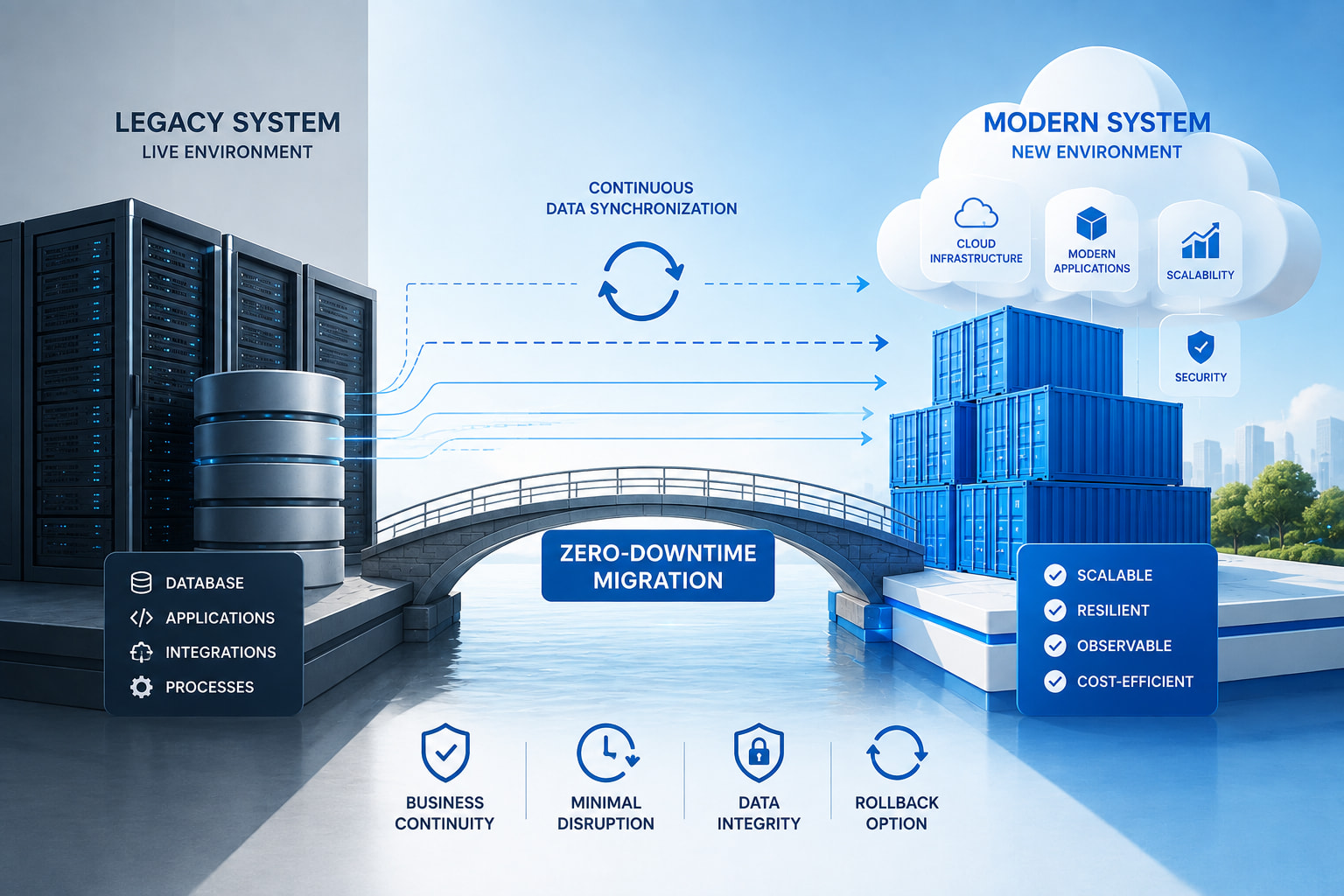
Software systems need to evolve. Infrastructure changes, technologies are modernized, databases are migrated, and applications adapt to new requirements.
But while technology changes, the business needs to keep running.
For a platform that is continuously used by customers, employees, or other systems, going offline for several hours simply because the infrastructure is being migrated can have a direct impact on operations.
This is where the concept of Zero-Downtime Migration comes in: designing the migration so that the transition to the new system takes place with as little disruption as possible.
Migration is more than simply transferring data
In an enterprise system, simply copying data from one environment to another is rarely enough.
Applications may depend on databases, APIs, external services, automated processes, and other systems. For this reason, before a migration begins, it is important to understand not only what is being moved, but also what depends on it. AWS migration guidance also highlights the identification of these dependencies as part of the preparation phase.
This is where architecture and technical planning become just as important as the migration technology itself.
The old and new systems can run in parallel
One way to reduce disruption is to prepare the new system while the existing one continues to operate.
In a database migration, for example, data can first be copied to the new environment, with subsequent changes continuously synchronized. The final transition takes place only once the two environments are synchronized.
The same approach can also be applied at the application level. With strategies such as blue/green deployment, the current version continues to serve users while the new environment is prepared and tested. Once it is ready, traffic can be redirected to it, while retaining the option to return to the previous version if necessary.
Modernization can happen gradually
Not every system needs to be replaced in a single step.
For large systems, a gradual migration can allow parts of the existing architecture to continue operating while new components progressively take over their responsibilities.
One example is the Strangler Pattern, where new functionality or APIs are built alongside the existing system and traffic is gradually redirected to them. This reduces the need for a single, immediate transition of the entire system.
Continuity is part of the architecture
For a software company, a successful migration is not measured solely by whether the system has moved to a new technology or infrastructure.
Data integrity must be preserved, dependencies must continue to function, and the transition should be controlled, testable, and, whenever possible, reversible.
As Ermal Beqiri, founder of Soft & Solution Group, says:
“System modernization should not be treated as a moment when the old technology is switched off and the new one is switched on. A well-designed migration preserves continuity, keeps the transition under control, and minimizes the impact on operations.”
The goal of modernization is not simply to move a system to new technology. It is to do so without forcing the business to stop along the way.