
Why Is System Integration Often More Complex Than Building a New Application?
Date: September 8, 2026
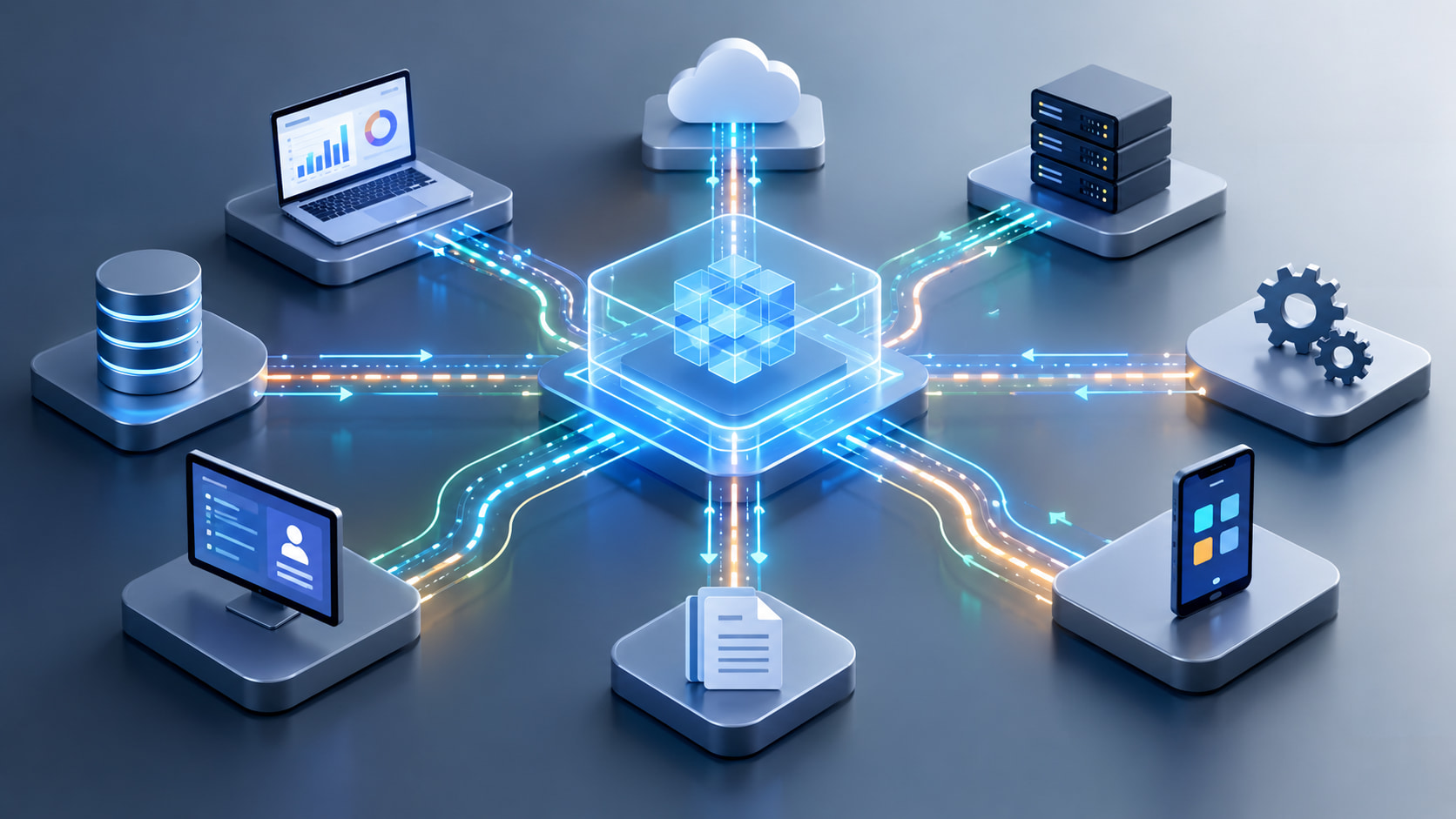
Building a new application means, to a large extent, defining how it will work from the outset: its architecture, data structure, technologies, and the way its components communicate with one another.
Integration is different.
When two or more existing systems need to work together, each comes with its own architecture, data, rules, and constraints. The challenge is no longer simply to build something that works, but to enable different systems to understand and exchange information with one another without disrupting their existing operations.
This is why System Integration can be one of the most complex parts of a software ecosystem.
Two systems can store the same information in completely different ways
One system may store a person using a first name, last name, and unique identifier. Another may store the full name in a single field and use a different identifier. One may update information in real time, while the other does so at predefined intervals.
To a user, they refer to the same person. To the software, they are two different data structures that need to be mapped correctly.
In large systems, this challenge multiplies across thousands of fields, documents, transactions, and relationships between data.
Integration, therefore, is more than transferring information. It must establish what that information means within each system and how its consistency is maintained.
An API does not automatically solve integration
APIs are one of the primary ways modern systems communicate, but the existence of an API does not automatically mean that two systems can be seamlessly integrated.
They may use different data formats, authentication methods, API versions, or rules governing how and how often information can be exchanged.
There is also the question of what happens when one system does not respond, when a request is sent twice, when an API changes version, or when a transaction succeeds in one system but fails in another.
The challenge, then, is not simply “how do we connect them?” but “how do we make that connection work reliably?”
Existing systems cannot stop whenever a new integration is built
This makes the challenge even more interesting.
Many of the systems being integrated are already active. They have users, data, and processes that must continue to operate while the integration is being developed.
A small change to a data structure or an API can affect other applications that depend on it.
For this reason, integration requires an understanding not only of the system being connected, but also of the dependencies surrounding it.
In some cases, the solution may be a direct API connection. In others, an integration layer, middleware, event-driven communication, or another mechanism may be required to avoid tightly coupling systems to one another.
The technology varies from one case to another. The principle remains the same: a new system must connect to the ecosystem without destabilizing what is already working.
Integration is also a data challenge
When multiple systems exchange information, another question arises: which system holds the authoritative data?
If an address is changed on one platform, should it automatically be updated across the others? If two systems update the same piece of information at the same time, which version should be retained?
Without clear rules, an integrated ecosystem can create the very problem it is intended to solve: multiple versions of the same information.
A well-designed integration therefore defines not only how data moves, but also which system owns it, when it is updated, and how conflicts are handled.
As more systems connect, architecture becomes increasingly important
A connection between two systems may appear relatively straightforward. But when an ecosystem includes dozens of applications, databases, and services, the number of dependencies can grow rapidly.
If every system connects directly to every other system, each change may require modifications across multiple points at the same time.
System Integration should therefore be approached as the architecture of the ecosystem as a whole, rather than as a series of individual connections. The way systems communicate today should support, rather than complicate, the addition or evolution of systems tomorrow.
As Ermal Beqiri, founder of Soft & Solution Group, says it:
“Systems create functionality. The connections between them create possibilities. The better those connections are designed, the more technology can evolve as a unified ecosystem.”
A well-designed integration is often almost invisible to the user. Information moves where it needs to go, systems continue to operate, and processes flow without requiring users to think about what is happening between applications.