
Why Can a Small Software Change Require Changes Across the Entire System?
Date: September 14, 2026
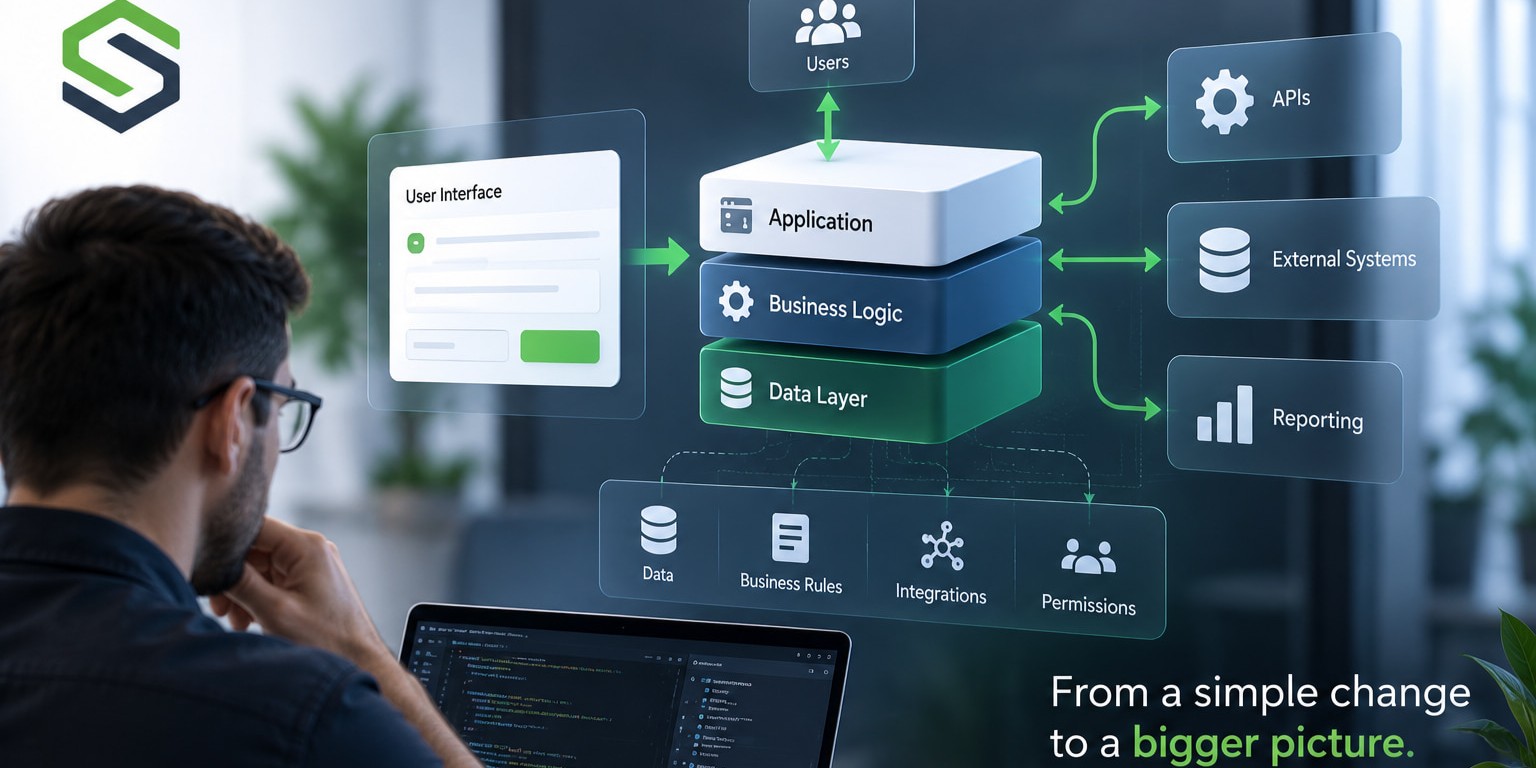
In software, the scale of a change is not always determined by what appears on the screen.
Adding a new field to a form, changing the status of a request, or introducing an additional approval step may seem like minor adjustments. But in a complex system, functionality rarely exists in isolation. It may be connected to data, process rules, users, APIs, reporting, and other systems.
That is why one of the first questions in software development is not simply “What needs to change?”, but also “What else will this change affect?”
What the User Sees Is Only One Part of the Functionality
Consider a simple example: a platform has an approval process, and a new approval level needs to be added.
In the interface, the change might amount to a new button, a new status, or an additional step. Within the system, however, it must be determined who is authorized to perform that action, at which stage it is allowed, what happens to the process status, what is recorded in the activity history, and which processes are triggered next.
If the same information is also used by other systems, the impact can extend even further. An API may need to transmit the new status, a report must interpret it correctly, and an integrated system needs to know how to handle it.
So, a single new element on the screen can represent several changes within the system architecture.
Software Works Through Dependencies
Modern systems are built from components that continuously communicate with one another.
One module may use data created by another. An API may send that data to another platform. A report may rely on the same data structure, while another process may be triggered automatically when the information changes.
These connections are precisely what allow a system to function as a whole. But they also mean that the impact of a change needs to be considered beyond the component where it begins.
For this reason, development does not end with implementing a requirement. It also requires understanding the chain of dependencies that the requirement affects.
A Change in Data Can Travel Across the Entire System
Data provides a clear example.
If a system begins storing a new piece of information, simply creating a place to store it is not enough. It must also be determined who creates it, who can modify it, where it is used, whether it needs to be shared with other systems, and how it will appear in reports or documents.
Even changing the meaning of an existing field can have an impact. Other components may have been built around the way that information was previously interpreted.
This is why, in complex systems, changing software also means managing the relationships between its components.
Integrations Extend the Impact Beyond the Application Itself
This becomes even more important when software is part of a larger ecosystem.
A system may exchange information with financial platforms, document management systems, identity services, other applications, or third-party platforms.
In this case, an internal change must also be assessed from the perspective of these integrations. A new data structure, a different rule, or a new status may require adjustments to the way systems communicate with one another.
The more connected a system becomes, the more important it is to understand the full impact of a change before implementing it.
The Most Important Work Often Happens Before the Code Changes
For this reason, a new requirement should not immediately be translated into code.
Before implementation begins, it is important to understand where the change fits, which components it affects, what data is involved, which integrations depend on it, and whether it has implications for other parts of the system.
This analysis is particularly important for platforms that have evolved over time, where functionality, data, and integrations are closely interconnected.
At Soft & Solution Group, system development is approached from precisely this perspective: a change is evaluated not only as an individual piece of functionality, but as part of the architecture and ecosystem in which it will operate.
As Ermal Beqiri, founder of Soft & Solution Group, says:
“In software, a change does not exist only where we can see it. It becomes part of the connections, data, and processes that hold the system together. Understanding these relationships before changing the code is just as important as the implementation itself.”
Software is constantly evolving. New functionality is introduced, processes change, and systems connect with new technologies.
That is why the ability to develop a system is not simply about adding new functionality. It is also about understanding how every change becomes part of the system that already exists.