
When One Integration Opens More Than One Door
Date: September 17, 2026
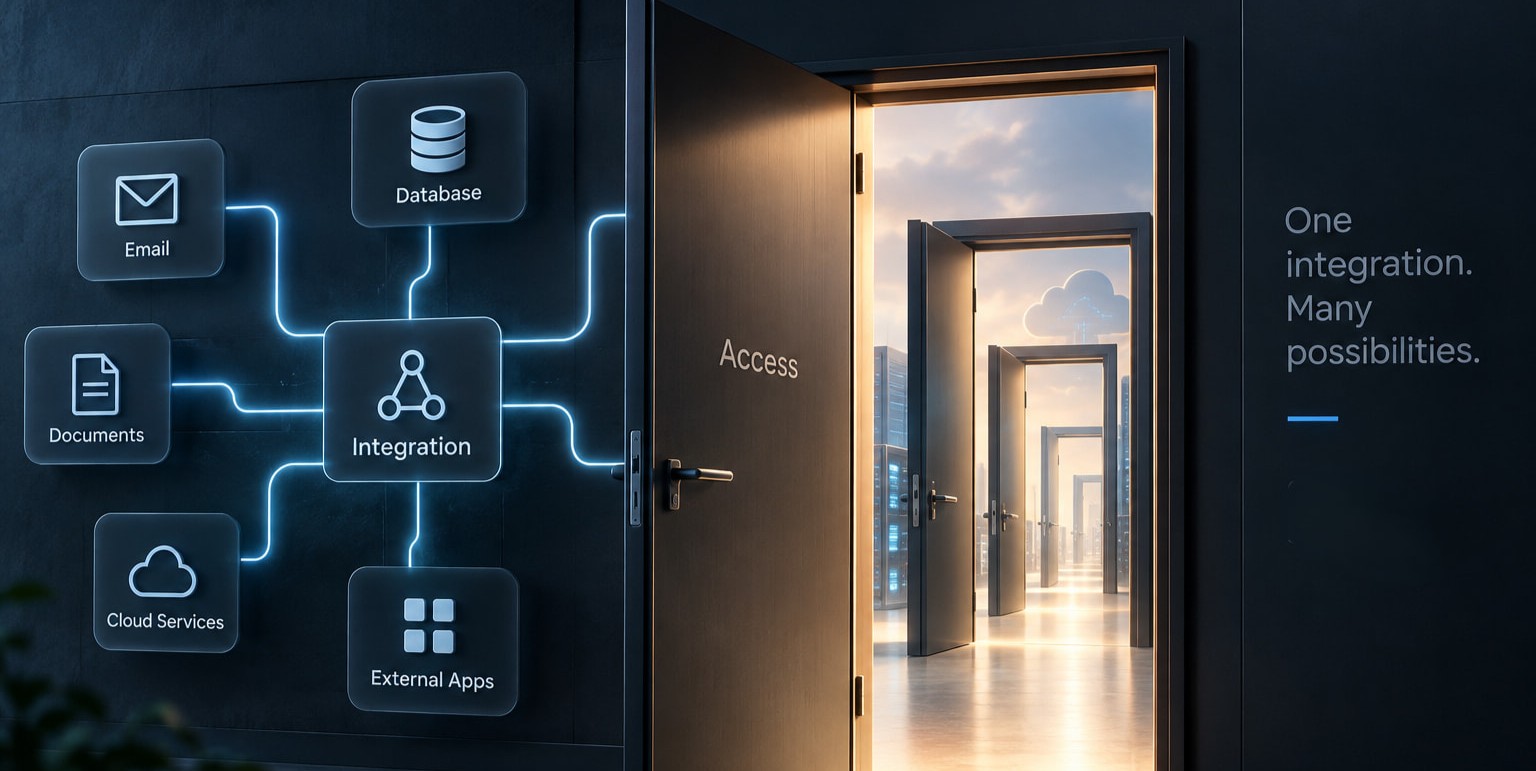
Modern systems rarely operate in isolation. A platform may connect to email, a database, a document management system, a cloud service, or an external application.
These integrations eliminate many manual processes and allow systems to operate as a unified ecosystem. But every connection also creates a relationship of trust: System A is granted the ability to perform actions within System B.
This changes how security needs to be approached. It is not enough to ask whether each system is secure on its own. We also need to understand what one system can reach through its connections to others.
An integration does more than transfer data
Consider a platform connected to a document management system.
The integration may have permission to read documents, create new ones, or modify existing information. Another integration may communicate with email, while another connects to a database or financial platform.
In each case, the connection represents more than a communication channel. It also carries a level of access.
This raises an important question when designing a system: if one component is compromised, how far could an attacker go using access that the system has legitimately granted?
This is not just a theoretical scenario. Microsoft documents how cloud applications can use connectors that store authorizations for email, SaaS applications, databases, and other services. If an attacker gains control of the resource managing a connector, that access can potentially be used to move into the connected service without necessarily extracting the original credentials.
A trusted system can become a path to another system
This creates an interesting situation.
System B may be configured correctly. User credentials may be protected. Authentication may be working exactly as intended.
However, if System A already has an authorized connection to it, compromising System A can change the entire security equation.
In cloud security, this relates to the concept of lateral movement: using one point of entry to reach other connected resources. Microsoft highlights how attack paths in cloud applications can extend from application code to identities, connectors, databases, and other cloud services.
Security architecture therefore needs to consider not only individual components, but also the paths created between them.
The problem is not the integration. It is how far access extends
An integration needs privileges in order to function. But there is no reason for it to receive more access than its purpose requires.
If a process only needs to read a specific category of documents, giving it access to an entire repository creates a larger exposure surface. If a service only needs to send information, allowing it to modify or delete that information introduces privileges the process does not need.
This is where the principle of least privilege becomes part of integration design itself: each connection receives only the permissions required to perform its intended function.
This control is becoming increasingly important as software ecosystems connect to more applications and services. Microsoft, for example, now provides attack-path mapping for OAuth applications to identify how a connected application could create paths to sensitive services and data.
Connections need to be designed with the same care as the systems themselves
When building an integrated platform, security questions need to go beyond simply asking, “Which system are we connecting to?”
What permissions does the connection have? What data can it read? What can it modify? Can the same authorization be used by another component? What happens when the integration is no longer needed? And above all, what other system can be reached through it?
These questions help prevent an integration from unintentionally becoming a bridge to other parts of the ecosystem.
Real-world incidents in recent years have demonstrated exactly this effect. Microsoft has documented incidents in which OAuth tokens and trusted SaaS integrations were used to maintain access to CRM systems and, in some cases, expand access into other connected platforms.
The security of an ecosystem is also shaped by the connections within it
At Soft & Solution Group, integration is not treated simply as an exchange of data between two applications. How systems authenticate, which privileges they receive, and how far each connection can reach are all part of the integration architecture.
As Ermal Beqiri, founder of Soft & Solution Group, says:
“When we connect two systems, we are not simply creating a path for data. We are also creating a relationship of trust. Architecture must clearly define how far that trust extends and what each connection is allowed to do.”
As more systems work together, the connections between them increasingly become part of the surface that needs to be protected.
Because a well-designed integration does not only determine how a door opens, but also how far someone can go once that door is open.