
What Happens When Two Users Change the Same Data at the Same Time?
Date: September 10, 2026
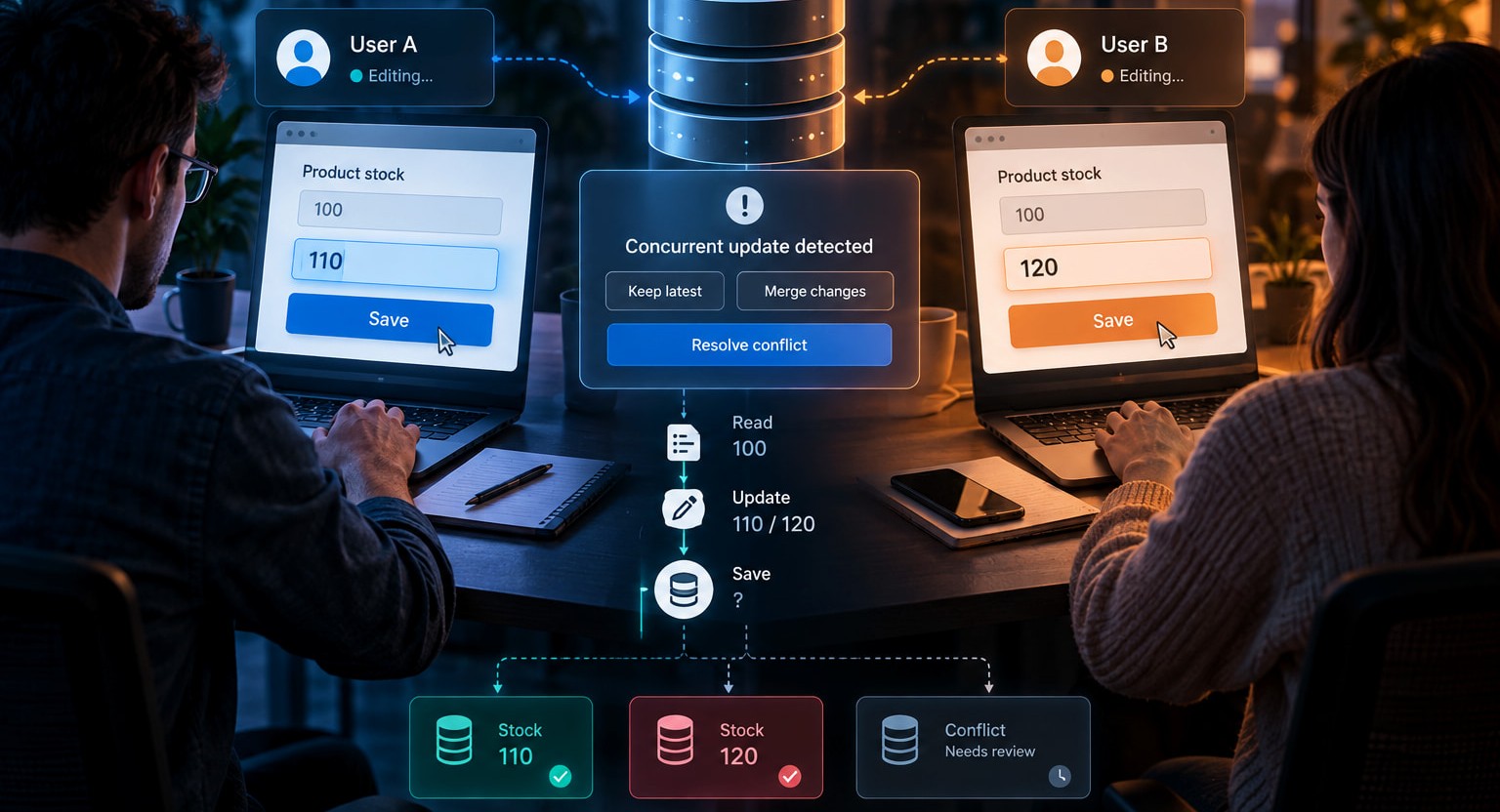
A system can perform perfectly with hundreds of users and behave very differently when activity grows to thousands of simultaneous requests.
At that point, server capacity is only part of the challenge. Multiple processes may read, modify, and exchange the same data almost simultaneously. A payment may be in the process of being confirmed while another process checks its status. A document may be updated while another service is using it. A request may be sent again because the first response was delayed, even though the original action was successfully completed.
In systems like these, speed only has value when it comes with control over what is happening in parallel.
As the System Grows, the Nature of the Problem Changes
One of the most common misconceptions about scaling is that a larger system primarily needs more processing power.
In practice, growth also creates more interactions between processes. The more users, services, and integrations operate simultaneously, the more important it becomes to coordinate how information is changed.
This is particularly relevant in platforms where a single action triggers several other processes. One request might update a database, communicate with another system, generate a document, and send a notification.
From the outside, it is one action. Within the architecture, it is a chain of processes that must preserve the same logic even when thousands of similar chains are running in parallel.
The Same Request Can Arrive Twice. The System Needs to Know.
One of the more interesting challenges in distributed systems is that a repeated request does not necessarily mean that the user performed the same action twice.
A connection may fail after the server has processed a request but before the response reaches the application. From the application’s perspective, the outcome is unclear: was the action completed or not?
In many architectures, the natural response is to try again.
But if the system has not been designed for this situation, a retry can become a second action: another payment, a duplicate record, or the same process being executed twice.
This is where an important principle of modern systems comes into play: idempotency. The system needs to recognize that a request has already been processed and, where the process requires it, return the existing result rather than executing the action again.
It is a good example of how system reliability is built around situations the user may never see.
Not Everything Needs to Happen in the Same Second
Another important consideration in the architecture of high-volume systems is how time is handled.
Not every process needs to be completed within the same request.
Some actions require immediate confirmation. Others can be queued and processed moments later. This is why modern systems use queues, events, and asynchronous processes to distribute workloads and prevent one part of the system from holding up the rest.
This creates a more resilient architecture, but it also introduces another responsibility: every part of the system needs to understand the current state of the process.
An operation may have been accepted but not yet completed. One service may already have processed it while another has not. At this level, managing the state of a process becomes just as important as processing the action itself.
“Correct” Does Not Always Mean “Updated Everywhere in the Same Millisecond”
When a system consists of multiple applications, databases, and services, another architectural decision emerges: how quickly should a change propagate across the entire ecosystem?
For some data, consistency needs to be immediate. For other data, a delay of a few seconds may be perfectly acceptable.
This distinction matters because attempting to synchronize every piece of information everywhere and at all times can introduce unnecessary complexity and workload.
Good architecture does not apply the same approach to every type of data. It defines where immediate consistency is required, where gradual synchronization is acceptable, and which system serves as the primary source of information.
Scaling Is a Coordination Problem, Not Just a Capacity Problem
More servers can be added. Database capacity can be increased. Traffic can be distributed across additional instances.
But without clear rules for coordinating actions, more capacity may simply mean more processes competing for the same data at greater speed.
This is where scalability and architecture come together.
At Soft & Solution Group, designing systems that need to operate at scale involves more than performance and infrastructure. It also means considering how data is managed, how parallel processes are coordinated, how services communicate, and how the system behaves when one component is delayed or a request is repeated.
A reliable platform needs to preserve the same logic even as its volume changes.
Architecture Becomes Most Visible When the System Is Under Pressure
During normal operation, many architectural decisions remain invisible. Their importance becomes clear when thousands of requests arrive simultaneously, a service responds more slowly than expected, a message is delivered twice, or several processes attempt to modify the same information.
As Ermal Beqiri, founder of Soft & Solution Group, says:
“In a complex system, every action is part of a larger chain. Architecture provides the structure that keeps these processes coordinated, the data accurate, and the system reliable even when many operations are taking place at the same time.”
A system designed to operate at scale is not simply built to do more things at once. It must ensure that, while everything is happening in parallel, the system continues to behave as a unified whole.