
What Happens When a System Goes Down for Five Minutes
Date: May 29, 2026
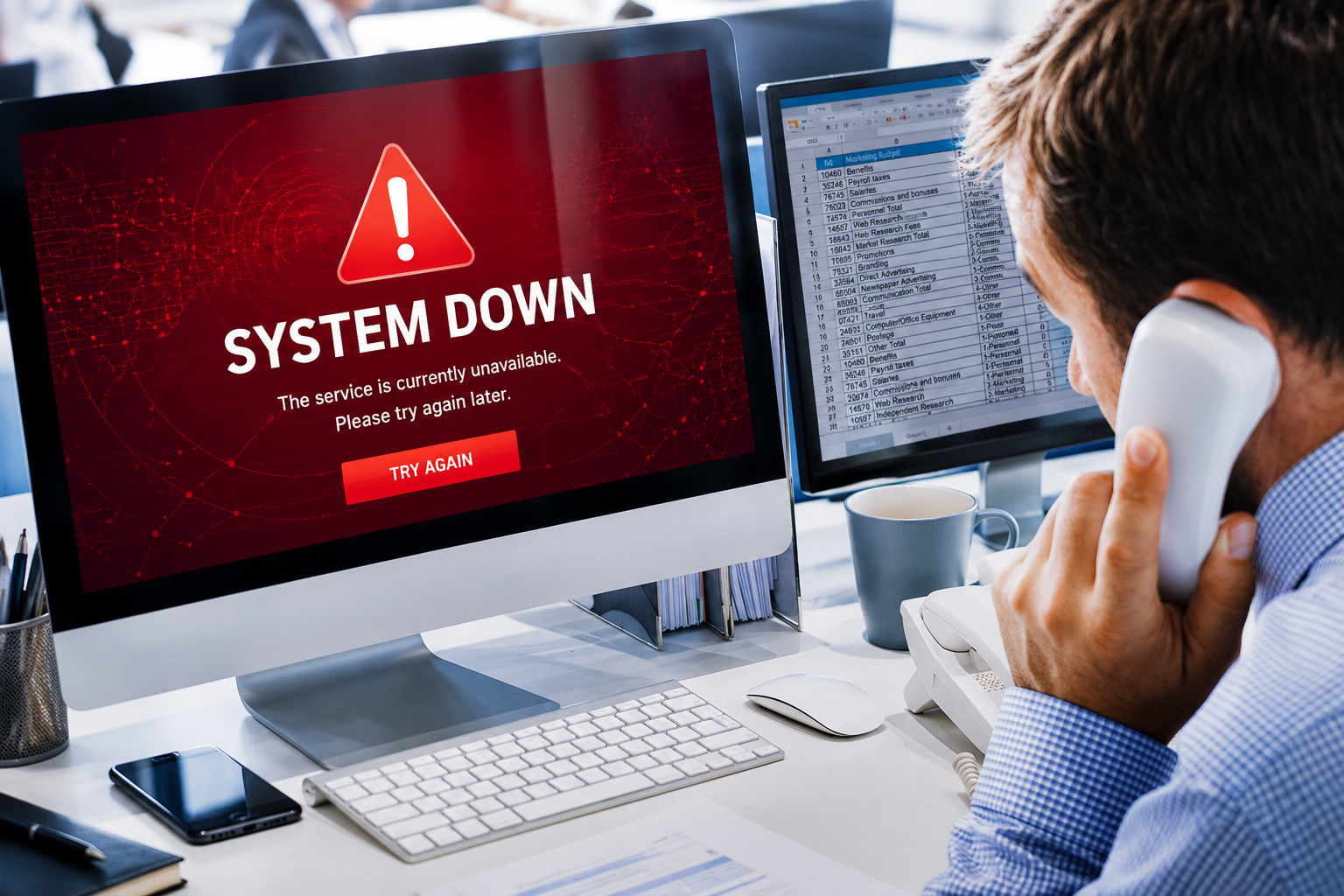
Five minutes does not seem like a long time.
In everyday life, it passes almost unnoticed. Yet in a system used by thousands or even hundreds of thousands of people, five minutes can have a far greater impact than it appears at first glance.
A service may become unavailable. A process may stop halfway through. An integration may stop communicating. A payment may fail to complete. A document may not be submitted on time.
But the more interesting question is not what happens when a system goes down for five minutes.
The real question is: what happens every day to prevent those five minutes from happening?
Stability Does Not Begin When a Problem Appears
Many people assume that system maintenance starts when an incident occurs.
In reality, the most reliable systems are those where most of the work happens long before users notice a problem.
At Soft & Solution Group, system monitoring goes far beyond checking whether a platform is online or offline. Service performance, response times, traffic patterns, databases, integrations, infrastructure resources, and other operational indicators are continuously monitored for signs that something may be moving away from normal behavior.
The goal is not to react when a system stops working.
The goal is to identify the warning signs much earlier.
Most Problems Leave Clues Before They Happen
In practice, many incidents do not occur without warning.
Gradually increasing response times, unusually high infrastructure consumption, sporadic integration failures, growing numbers of log errors, or unexpected traffic patterns are often early indicators of a potential issue.
This is why 24/7 monitoring and automated alerting mechanisms have become essential parts of modern system operations.
The earlier a deviation is detected, the greater the chance it can be resolved before it affects users or active processes.
What Happens During Those Five Minutes
When an incident occurs, every minute matters.
Technical teams do not focus solely on restoring the service. At the same time, processes are activated to analyze the cause, assess the impact, monitor connected systems, and verify integrations that may also be affected.
In critical environments, the interruption of a single component can affect multiple processes simultaneously. For this reason, incident management requires more than a rapid response. It requires a deep understanding of the system architecture and how its different components interact.
Once the service has been restored, the work is not over.
Root cause analysis, incident documentation, and preventive measures are all part of the process that helps reduce the likelihood of similar situations in the future.
Maintenance Is Part of the System
A platform does not remain unchanged after launch.
User volumes grow, new integrations are added, operational requirements evolve, and the infrastructure supporting the platform continues to change.
For this reason, maintenance is not treated as a post-development activity. It is considered part of the system’s lifecycle.
Capacity planning, performance optimization, controlled updates, continuous monitoring, and service-level management all play a direct role in maintaining the long-term stability of a platform.
Reliability Is Built Every Day
As Ermal Beqiri, founder of Soft & Solution Group, says:
“Five minutes offline may not seem like much. But when thousands of people rely on a system, those five minutes are enough to remind us how important the daily work behind stability really is.”
The value of a system is not measured only by the features it offers. It is measured by its ability to remain stable, available, and reliable when people need it most.