
Vendor Lock-in: The Risk Many Companies Recognize Only When It’s Too Late
Date: August 6, 2026
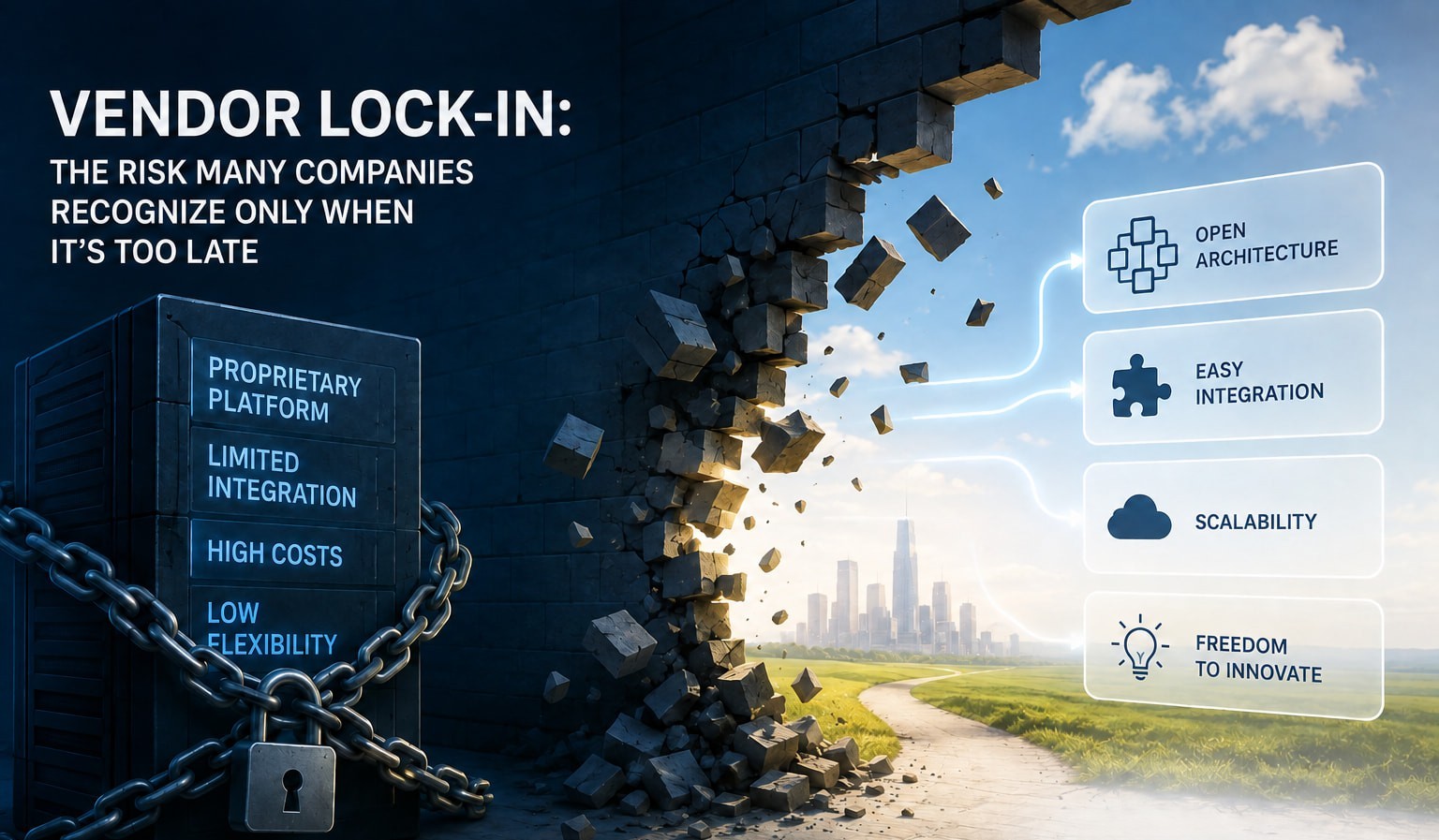
Vendor Lock-in: The Risk Many Companies Recognize Only When It’s Too Late
When organizations choose a technology platform, the focus is often on features, pricing, or implementation timelines. Yet one of the most important considerations is frequently overlooked: how easy will it be to adapt or change direction in the future?
This is the essence of what is known as vendor lock-in.
It is not a problem that appears overnight. It develops gradually and often becomes visible only when an organization needs to integrate new systems, migrate to another platform, or adopt emerging technologies.
When Technology Starts Limiting the Business
Vendor lock-in occurs when an organization becomes overly dependent on a single technology provider, platform, or ecosystem.
Over time, every change becomes more complex, more expensive, and more risky. System integrations become limited, data migration becomes increasingly difficult, and introducing new technologies requires greater time and investment.
At that point, the business is no longer in control of its technology. Instead, the technology begins to dictate the business’s options.
The Real Cost Is Not the License
Many organizations evaluate technology platforms based on implementation costs or licensing fees.
However, the greatest costs often emerge years later.
When systems cannot integrate easily with new platforms, when data cannot be migrated efficiently, or when every upgrade depends on a single vendor, organizations lose the flexibility needed to respond to changing business requirements.
That is why vendor lock-in is widely considered one of the most significant hidden costs of digital transformation.
Open Architecture Creates Freedom
Modern organizations are increasingly adopting open architectures, interoperable standards, and API-driven ecosystems that simplify integration.
The objective is not to avoid working with technology vendors.
The objective is to preserve the freedom to evolve.
An open architecture enables organizations to introduce new platforms, replace individual components, and adopt innovative technologies without rebuilding their entire digital ecosystem.
Freedom of Choice Is a Strategic Advantage
Technology will continue to evolve.
New platforms will emerge.
Business models will continue to change.
Organizations that build flexible technology foundations will always be better positioned to adapt.
Ultimately, the value of a digital system is measured not only by what it delivers today, but by its ability to support tomorrow’s opportunities.
As Ermal Beqiri, founder of Soft & Solution Group, explains:
“When you build a system, you shouldn’t think only about how it will perform today. You should also think about how easy it will be to change it five or ten years from now. That’s what separates a short-term solution from a long-term investment.”
At Soft & Solution Group, we believe digital transformation should create flexibility, not dependency. That is why we design solutions based on open architectures, modern standards, and scalable integrations, giving organizations the freedom to innovate, grow, and make strategic decisions without being constrained by technology.