
Software Supply Chain Attacks: When a Software Update or Package Becomes a Business Risk
Date: November 19, 2026
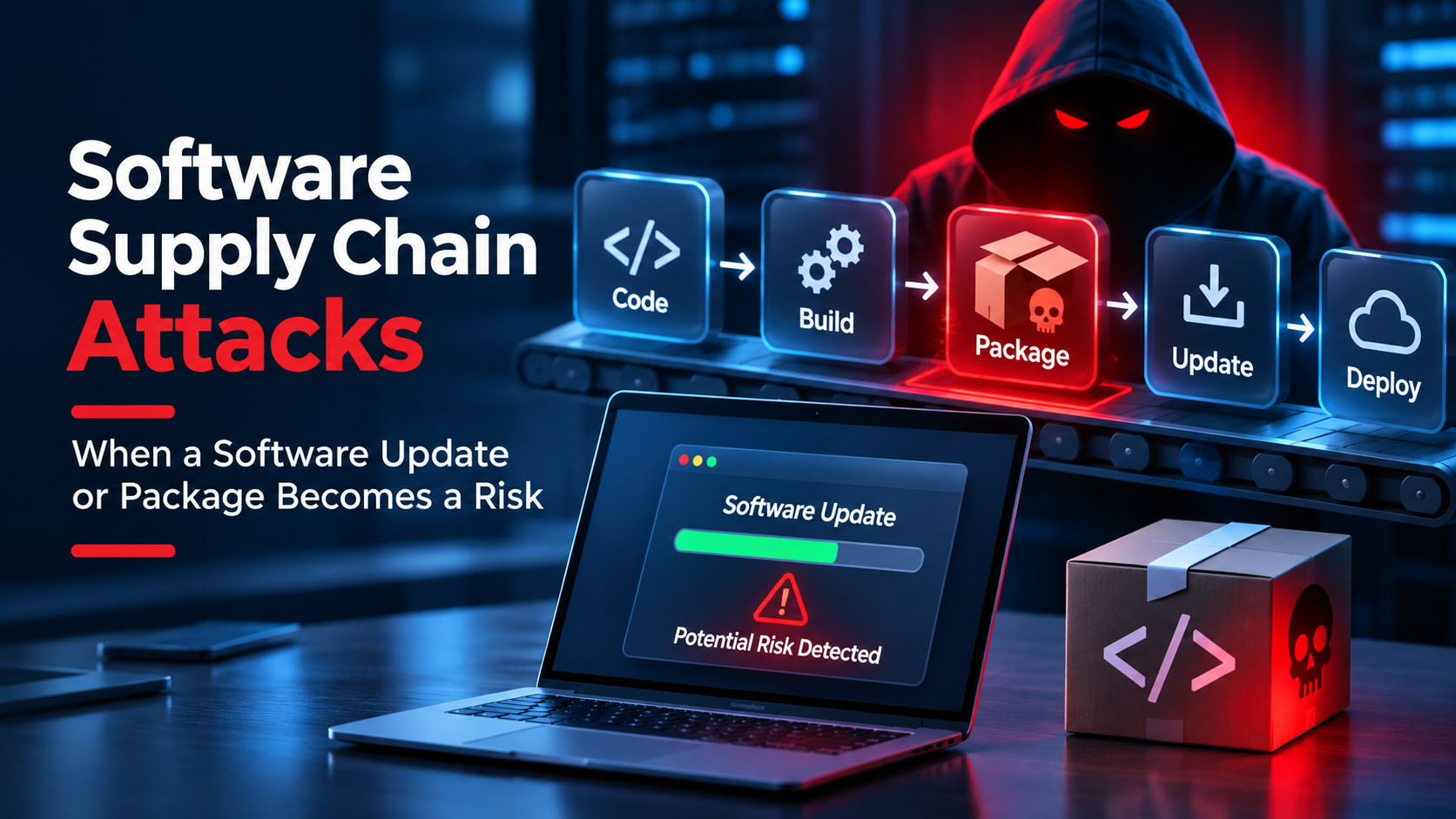
In an environment where businesses rely on dozens of applications, programming libraries, software packages, and cloud services, security no longer depends solely on protecting internal systems. A routine update, a package downloaded from a repository, or a tool used by developers can become the entry point for a cyberattack. This is why Software Supply Chain Security is becoming one of the major priorities for technology-dependent organisations.
Over the past few days, reports of compromised packages across npm and PyPI ecosystems have renewed attention on the risks associated with software components that are normally considered trustworthy. Incidents reported on November 17 and 18, 2026, included malicious packages capable of compromising developer devices and exposing credentials used in cloud and CI/CD environments.
Source: Threat Watch, Incident Archive, November 17–18, 2026; Vulnpocalypse, Supply-chain Attack Tracker, November 18, 2026.
For businesses, these incidents demonstrate that threats do not come exclusively from phishing emails, exposed servers, or direct attacks. A trusted software component can become the weakest link in an entire infrastructure. Soft & Solution Group considers software supply chain security an essential part of modern IT strategy, particularly for companies relying on automation, cloud computing, and continuous application development.
What is a Software Supply Chain Attack?
A Software Supply Chain Attack is a cyberattack that targets a component, tool, process, or supplier involved in the development, distribution, or maintenance of software. Instead of attacking a company directly, cybercriminals may compromise a package used by developers, a publisher’s account, a repository, a plugin, or an automated pipeline.
This allows malicious code to be distributed through a channel users normally consider safe. When a package is installed or a build process is executed, the malicious code may activate without being immediately visible during normal application usage.
How can a software package become a threat?
Many modern applications rely on external packages to perform different functions. Developers install these components from repositories such as npm or PyPI, relying on their reputation, documentation, and published versions.
Attackers may create packages with names similar to legitimate ones, compromise publishing accounts, or inject malicious code into new versions of existing packages. In some cases, malicious activity is triggered during installation through automated scripts, without requiring the developer to directly use the compromised functionality.
One of the most serious risks is credential theft. Malicious packages may search for GitHub tokens, API keys, cloud credentials, CI/CD secrets, and information stored in development environments. If these credentials have elevated permissions, attackers may move from a developer’s device into repositories, servers, or other company services.
Why are CI/CD and cloud environments particularly exposed?
CI/CD pipelines automate processes such as testing, building, releasing, and deploying applications. To perform these tasks, they often have access to tokens, keys, private repositories, and cloud infrastructure. This makes them valuable targets for cybercriminals.
If a compromised package runs inside a pipeline, malicious code may attempt to collect available credentials, modify build processes, or compromise artifacts that are subsequently distributed to other systems. In this scenario, a single incident may affect not only a developer but also the products a company builds and delivers to its customers.
This is why software security must include dependency controls, release verification, privilege restrictions, and monitoring of automated pipelines.
What are the real risks for businesses?
The consequences of a software supply chain attack can extend beyond a compromised computer. An incident may result in sensitive data exposure, credential theft, unauthorised access to cloud systems, service disruption, code manipulation, and malware spreading into other environments.
For companies developing software or providing digital services, there is also the risk that a compromised component becomes part of a product delivered to customers. This can affect business reputation, partner relationships, recovery costs, and operational continuity.
How can businesses protect themselves from Software Supply Chain Attacks?
Protection begins with controlling the components used during software development. Businesses should maintain an inventory of software dependencies, verify package sources, and avoid installing unknown components without security checks. Using lockfiles, pinned versions, and automated dependency analysis helps control unexpected changes.
Privilege restriction is equally important. Tokens and credentials used in CI/CD pipelines should have only the permissions required, be stored securely, and be rotated regularly. Companies should enable multi-factor authentication for critical accounts, monitor unexpected repository changes, and review new package releases.
Organisations should also maintain an incident response plan that includes isolating affected environments, revoking compromised credentials, investigating suspicious activity, and rebuilding systems from verified sources.
Conclusion: software trust must be verified
Software Supply Chain Attacks demonstrate that a company’s security is not determined solely by firewalls, antivirus software, or server protection. It also depends on every package, library, update, plugin, and automation process used to build and operate its systems.
In an economy increasingly dependent on software, companies need to move from automatic trust to continuous verification. Dependency control, credential protection, CI/CD monitoring, and rapid incident response are no longer just technical practices—they are part of business strategy.
Soft & Solution Group recommends treating software supply chain security as an ongoing process, evaluating every component that may affect the integrity, performance, and security of business systems.
As Ermal Beqiri, founder of Soft & Solution Group, explains:
“System security depends not only on the technology we build, but also on every component we choose to trust. In an interconnected digital environment, software verification is just as important as software development itself.”