
Shadow AI: The Invisible Risk Entering Every Organization
Date: July 30, 2026
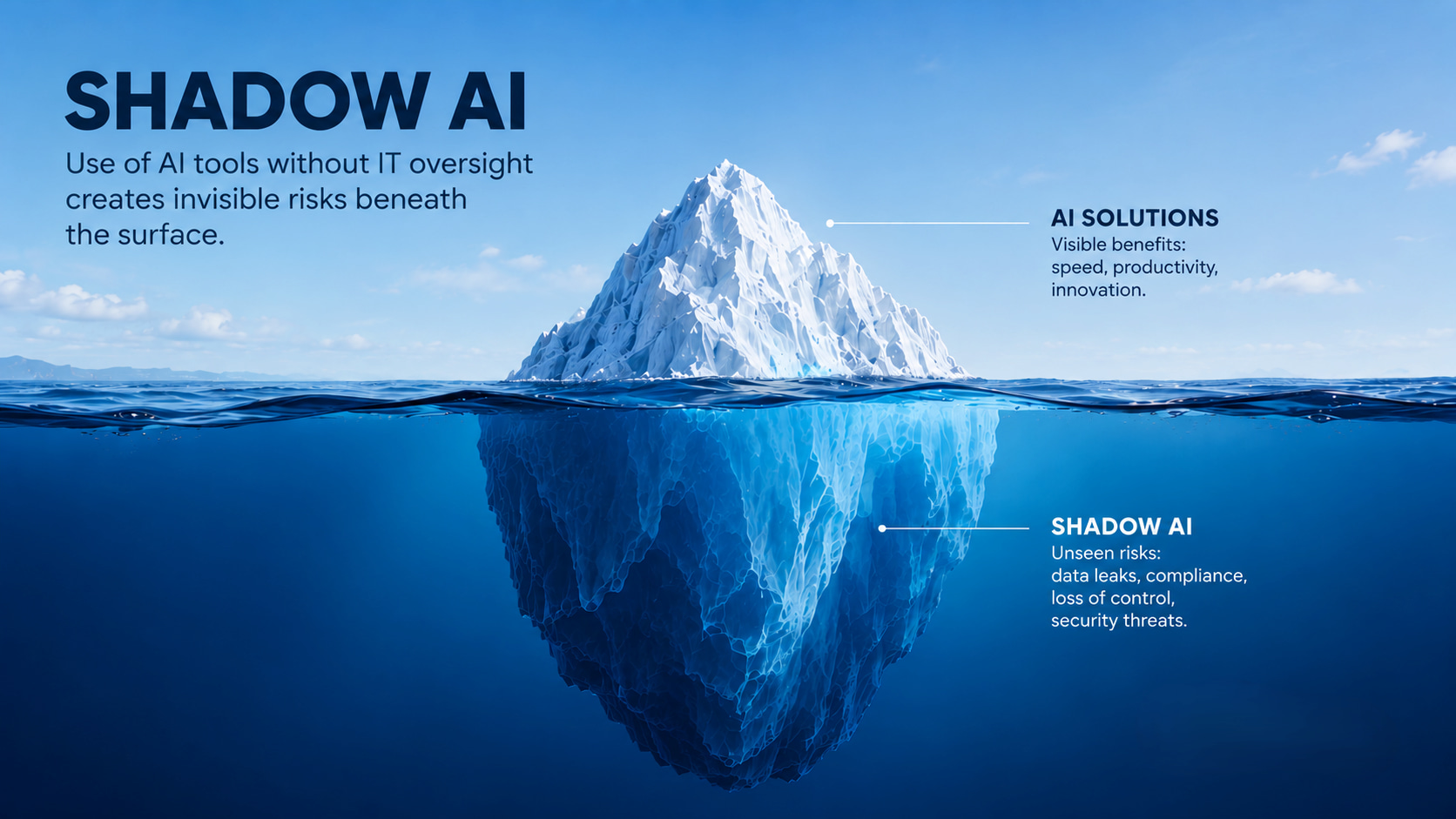
Artificial Intelligence is transforming the way we work. Every day, millions of professionals use tools such as ChatGPT, Copilot, Gemini, and other AI platforms to draft documents, analyze data, create presentations, and automate everyday tasks.
In many cases, these tools are being adopted without any involvement from the IT department.
Employees embrace them because they are fast, intuitive, and highly effective at improving productivity. Yet this widespread adoption has created a new challenge for organizations.
This phenomenon is known as Shadow AI.
When Artificial Intelligence Enters the Organization Without Governance
Shadow AI refers to the use of Artificial Intelligence tools without the organization’s approval, oversight, or governance.
An employee may upload a confidential contract to an AI chatbot for summarization, analyze financial data using an external AI model, or automate business processes through an unapproved platform.
In most cases, the intention is simply to work more efficiently. However, the absence of visibility and control introduces risks that often remain unnoticed until a security incident occurs.
The Risk Is Not Artificial Intelligence. The Risk Is the Lack of Governance.
Many organizations view Shadow AI as a technology issue.
In reality, it is a digital governance challenge.
When IT departments have no visibility into which AI tools are being used, what data is being shared, or who has access to that information, maintaining security, protecting privacy, and ensuring regulatory compliance become significantly more difficult.
As a result, organizations gradually lose control over part of their own digital ecosystem.
Productivity Should Never Come at the Expense of Security
Artificial Intelligence is one of the most transformative technologies of this decade, and organizations should not discourage its adoption.
Instead, they should establish clear AI usage policies, define which platforms are approved, determine what types of data may be processed, and continuously monitor how these technologies are being used.
When AI is governed effectively, it enhances productivity without compromising security.
AI Governance Will Become as Essential as Cybersecurity
Just as organizations invested in cloud governance, digital identity management, and Zero Trust strategies, they must now develop a comprehensive approach to AI Governance.
AI Governance extends far beyond selecting AI platforms. It includes access management, data protection, transparency, auditing, accountability, and the responsible use of AI models.
Organizations that build these governance frameworks today will be significantly better prepared for the technological and regulatory challenges of tomorrow.
The Future Belongs Not Only to Organizations That Use AI, but to Those That Govern It
Shadow AI is not a temporary trend. It is a natural consequence of the rapid adoption of Artificial Intelligence across every industry.
The challenge is not to prevent employees from using AI. The challenge is to ensure that AI is secure, governed, and aligned with the organization’s business objectives.
As Ermal Beqiri, founder of Soft & Solution Group, explains:
“The more Artificial Intelligence becomes embedded in business processes, the more essential AI governance becomes. Organizations that establish clear governance frameworks today will be the ones that unlock the greatest value from AI tomorrow.”
At Soft & Solution Group, we believe digital transformation is not only about adopting emerging technologies. It is about building the governance, security, and operational frameworks that enable those technologies to be used responsibly and sustainably. Artificial Intelligence will continue to reshape the way organizations operate. The real challenge is ensuring it always remains under control.