
Is the Coding Agent as Secure as the Code It Writes?
Date: October 5, 2026
For years, one of the main questions in software development has been: is the code secure?
Developers analyze vulnerabilities, check dependencies, test applications, and determine which users can access different parts of a system.
But the introduction of coding agents into the development process is creating another question.
Is the agent that writes and executes code as secure as the software we are trying to build?
This question becomes increasingly important as AI agents move from suggesting a few lines of code to performing real actions within development environments.
A coding agent can read files, modify code, execute commands, install dependencies, use tools, and, in certain configurations, communicate with services over the network.
At this point, security is no longer only about the code AI produces.
It is also about the environment in which AI is allowed to operate.
From an Assistant That Suggests Code to an Agent That Executes Commands
The first generation of AI programming tools primarily functioned as suggestion systems.
The developer wrote code, and the model proposed functions, code snippets, or possible solutions.
Coding agents are changing this model.
An agent can receive a task, analyze the repository, identify the files that need to be changed, modify the code, and execute tools to verify the result.
GitHub describes this evolution of Copilot from an assistant inside the editor toward a development partner that can use tools, execute commands, and modify files.
The more actions an agent can perform, the more important the question becomes: what is it allowed to access?
An error in a text response can be corrected before it is used.
A command executed in a real system can have immediate consequences.
A Coding Agent Should Be Treated as a System User
From an architectural perspective, a coding agent should not be viewed only as an AI model.
It is becoming an active actor within the system.
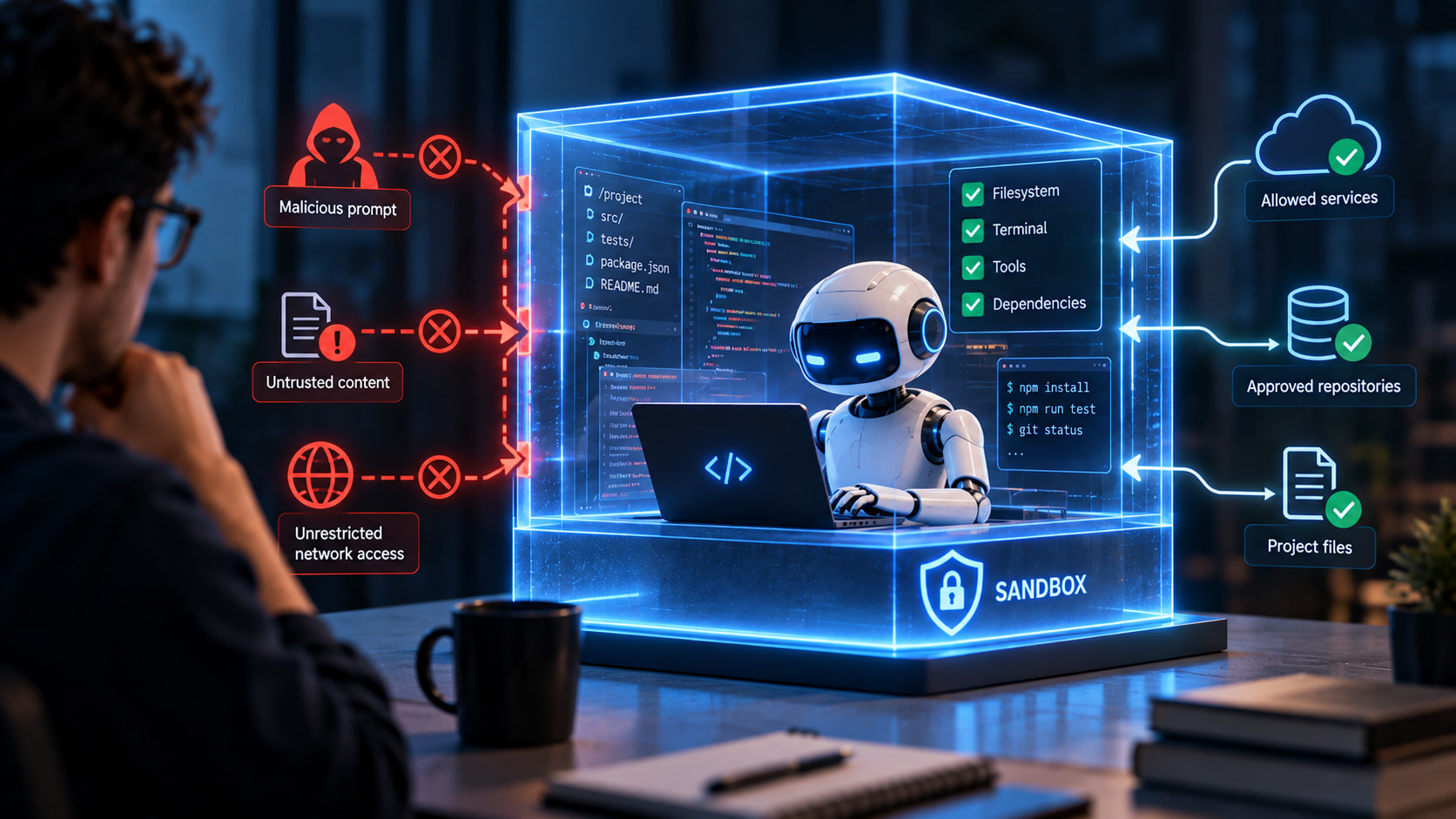
If it can read the file system, use the terminal, and communicate over the network, then it has an access surface that must be controlled.
This is similar to how modern systems treat users and services.
An application should not give every user access to every resource. In the same way, a coding agent should not automatically have access to an entire computer simply because it needs to modify a repository.
The principle becomes simple:
The agent should have only the access it needs to complete the task.
This is a direct application of the principle of least privilege to AI-driven development.
The Sandbox Is Becoming the New Security Boundary
On June 2, 2026, GitHub introduced cloud and local sandboxes for GitHub Copilot in public preview.
The goal is to allow Copilot’s actions to run within isolated environments rather than giving the agent unrestricted access to the system where the developer is working.
In a local sandbox, commands and tools executed by the agent can have restricted access to the file system, network, and system capabilities.
A cloud sandbox goes one step further by moving the session into an isolated, temporary Linux environment hosted by GitHub.
This creates an important architectural separation.
Instead of allowing the coding agent to execute every action directly on the primary system, it is placed within a boundary where the resources it can use can be defined.
In this way, the sandbox is not simply an additional security feature.
It is becoming the execution layer for coding agents.
The File System Is One of the Most Important Boundaries
A coding agent working on a project needs to read and modify files.
But that does not mean it should be able to read every file that exists on the developer’s device.
GitHub’s current documentation allows sandbox file system access to be configured according to specific paths. Certain areas can be readable and writable, others read-only, while some can be blocked entirely.
This creates a much more controlled model.
The agent can access the repository where it needs to work without necessarily having the same freedom across the rest of the system.
This distinction becomes particularly important when the developer’s device contains other projects, configurations, credentials, or data unrelated to the agent’s task.
The Network Creates Another Problem: Data Exfiltration
The file system controls what the agent can read or modify.
The network controls where it can send information.
A coding agent may have legitimate reasons to access the internet. It may need to download a dependency, contact a package registry, or use a service required during the development process.
But unrestricted network access also creates risk.
GitHub connects restrictions on internet access with managing the risk of data exfiltration. Unexpected agent behavior or malicious instructions can create situations in which code or other sensitive information is sent, or an attempt is made to send it, to an external destination.
For this reason, the Copilot cloud agent uses a firewall to restrict internet access, and organizations can control which destinations are allowed.
This shifts security away from the question:
“Do we trust the model?”
toward a more practical question:
“Even if the model makes a mistake, what does the infrastructure allow it to do?”
Prompt Injection Is No Longer Just a Chatbot Problem
Another risk appears when agents receive instructions from content that is not fully controlled by the developer.
GitHub warns that content in issues or comments can be used in attempts to perform prompt injection against the cloud agent.
This is particularly important for coding agents because they do not only produce text.
They can perform actions.
In a traditional AI system, a malicious instruction may influence the model’s response.
In a system with tools, the same problem may attempt to influence which commands the agent executes, which files it reads, or which services it communicates with.
Therefore, protection cannot rely solely on the model’s ability to distinguish safe instructions from unsafe ones.
Technical boundaries must exist outside the model.
Credentials Should Be Treated as a Privilege, Not a Default
One of the most sensitive resources that can be given to a coding agent is credentials.
If an agent can use Git or the GitHub CLI with the developer’s identity, it may be able to perform actions that go beyond modifying a local file.
For this reason, sandbox configuration should determine not only access to files and the network, but also which credentials are available during execution.
This is another reason why coding agents should be treated as operational identities within the architecture.
The question should not only be “what does the agent know?” but:
What can the agent do with the identity we have given it?
A Sandbox Reduces Risk, but Does Not Eliminate It
Isolation is an important security layer, but it should not be treated as an absolute guarantee.
GitHub’s own documentation highlights firewall limitations and warns that sophisticated attacks may attempt to bypass these protections.
Likewise, a coding agent may generate code that appears correct but contains functional errors or security vulnerabilities.
This means there are two different problems.
The first is the security of the code produced by the agent.
The second is the security of the actions performed by the agent while producing that code.
The sandbox primarily helps address the second problem.
Code review, testing, static analysis, and security checks remain necessary for the first.
Human Review Remains Part of the Security Model
The autonomy of coding agents should not mean the absence of human oversight.
GitHub recommends reviewing an agent’s output before merging it into the main codebase and applies additional restrictions to the cloud agent.
For example, the agent has limited repository access, cannot push changes directly to the main branch, and certain workflows require human approval before they can run.
These measures demonstrate a broader principle for the architecture of AI systems:
Autonomy should increase alongside control.
The more actions an agent can perform, the clearer its boundaries, permissions, traceability, and human approval points must become.
Coding Agent Security Is Becoming an Architectural Problem
For Soft&Solution Group, development with coding agents should be treated as an architectural change, not simply as the adoption of a new productivity tool.
The moment an AI system can use the terminal, modify files, communicate over the network, and operate with credentials, it becomes an active part of the system’s security model.
This means that teams should define access boundaries before defining the level of autonomy.
As Ermal Beqiri, founder of Soft&Solution Group, puts it:
“A coding agent does not become secure simply because the model is advanced. Security begins with the boundaries we build around it: what it can read, what it can modify, where it can communicate, and which actions require human approval. The more autonomous AI becomes, the more important the architecture that controls that autonomy becomes.”
Coding agents are changing the way software is built.
But the evolution from code suggestion to autonomous execution also creates a change in how security must be approached.
It is no longer enough to examine only the code that comes from AI.
We must also control the environment in which AI operates.
The file system, network, credentials, sandbox, access policies, and human approval are becoming parts of the same security architecture.
In this model, a coding agent should not be considered a process that is automatically trusted.
It should be treated as a component with limited privileges, observable behavior, and controllable actions.
Because in AI-driven software development, the next security question will not only be:
“Is the code secure?”
But also:
“Was the agent that built it secure?”