
How to Build a Structure That Performs Even When Conditions Change
Date: April 24, 2026
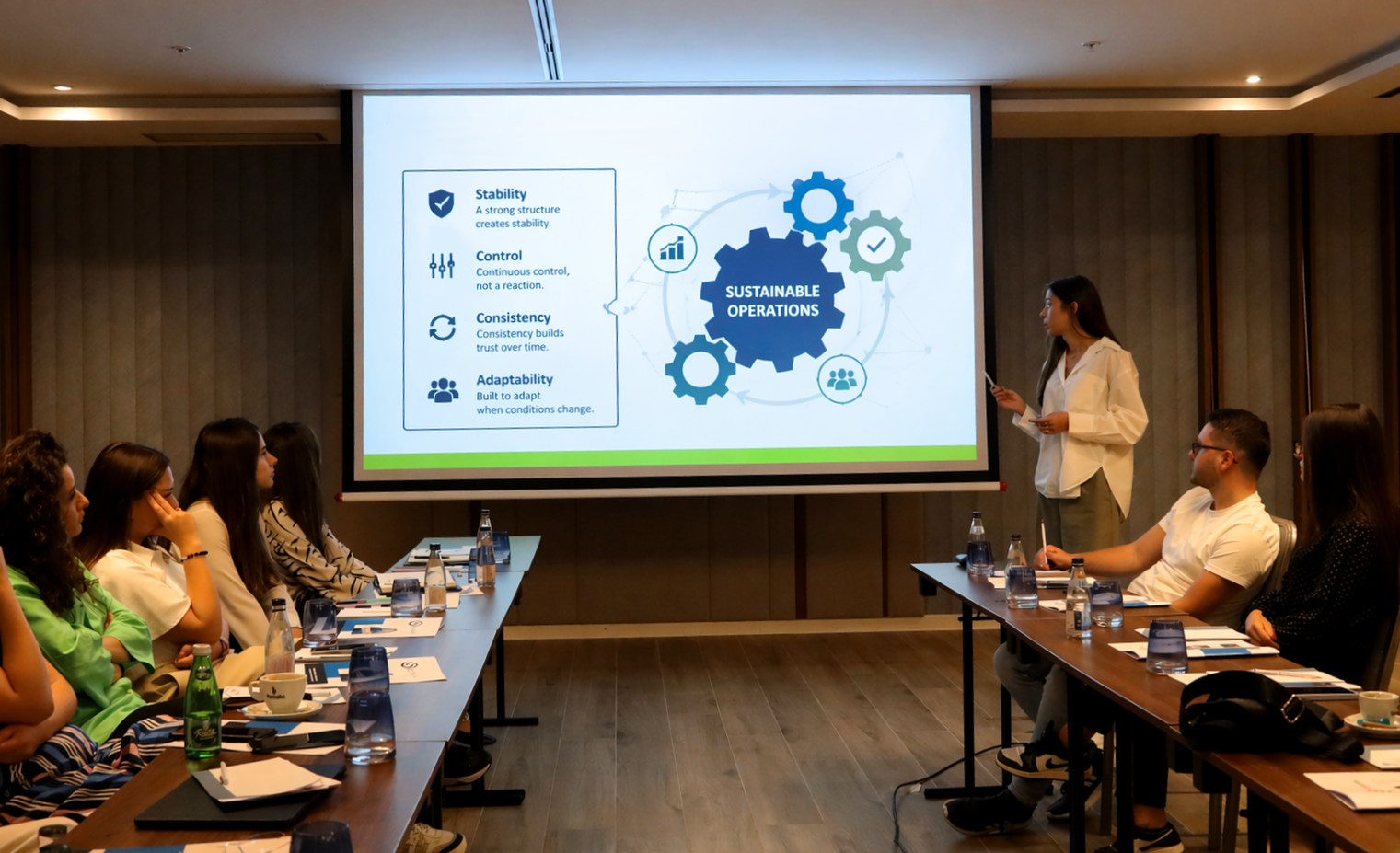
In most cases, an operating model only becomes visible when something stops working. When conditions are stable, many structures are able to perform. The real challenge begins the moment those conditions change.
It is precisely in these moments that it becomes clear whether an operating model has been built for long-term stability or simply for functioning under ideal circumstances.
Stability depends on structure, not conditions
A strong operating model is not one that performs only when everything is predictable. It is one that maintains clarity and control even as complexity increases.
This requires a structure that does not rely on improvisation, but on clear principles of organization, accountability, and decision-making.
When these elements are well established, changing conditions do not destabilize operations. They become part of how operations are managed.
Control as a continuous element, not a reaction
Many organizations attempt to restore control only after it is lost. A sustainable operating model does not rely on reaction, but on anticipation.
Control should not be a late intervention. It must be embedded in the way operations are managed every day.
This creates an environment where decision-making remains clear and consistent, regardless of changing conditions.
Consistency as the foundation over time
A sustainable operation is not defined by moments when everything goes well, but by how it responds to change.
Consistency in the way work is organized creates a rhythm that is not easily disrupted. It allows the structure to remain functional even as pressure increases.
In this sense, stability is not a coincidence. It is the result of how operations are structured and maintained over time.
An approach built over time
An operating model is not something defined in a single moment. It is built progressively, through how decisions are made, how work is organized, and how control is maintained at every stage.
As Ermal Beqiri, founder of Soft & Solution Group, explains:
“In practice, you come to understand that an operating model is not built for moments when everything goes well, but for situations where reality shifts and structures are put under real pressure. It is in those moments that the foundations become visible. Because real value does not lie in functioning under ideal conditions, but in the ability to maintain control and direction as complexity increases.”
In an environment where change is constant, what makes the difference is not only strategy or technology, but how operations are structured.
Structures that endure over time are those that maintain control, clarity, and consistency, even as conditions evolve.