
How Much Software Is Really Inside a Piece of Software?
Date: September 9, 2026
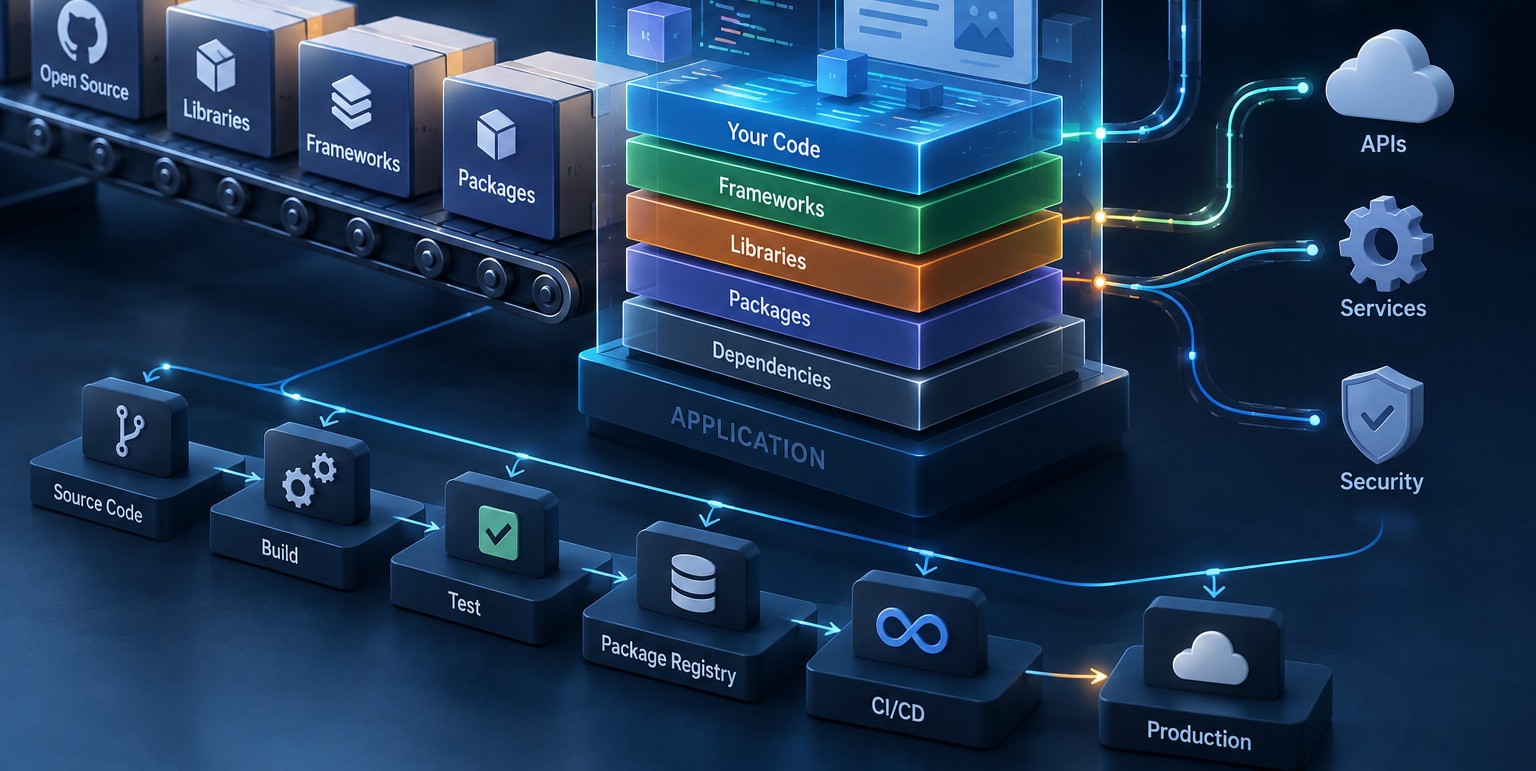
When a software platform is built, the code developed specifically for that system is only one part of the technology that makes it work.
Behind it may be frameworks, libraries, packages, databases, APIs, and other components that serve different purposes, from authentication and data communication to logging and security.
This is how modern software is built. Teams rely on proven technologies and existing components rather than developing every function from scratch.
But as a system becomes more complex, another question becomes increasingly important: do we know exactly what it is built on?
This is where the Software Supply Chain begins.
Every Component Becomes Part of the System
In a software project, choosing a library or framework may seem like a relatively small decision. In reality, that component becomes part of the system’s lifecycle.
It has its own version, dependencies, security updates, and maintenance cycle. Over time, it may be updated, changed, or eventually reach the end of its support.
For systems expected to operate and evolve for years, this matters.
At Soft & Solution Group, system development is considered beyond the functionality that needs to be delivered. Architecture must also take into account the technologies and dependencies the system will rely on throughout its lifecycle.
Because a technical decision made today becomes part of how the system will be maintained tomorrow.
Every Component Expands the System’s Ecosystem
A third-party component may represent only a small part of an application, but once it is introduced, it becomes part of the technology landscape that needs to be continuously managed.
Versions change, updates are released, new security vulnerabilities emerge, and some technologies eventually need to be replaced. A component may also rely on other components, creating multiple layers of dependencies within the same system.
In complex systems, what matters is not only choosing the right technologies, but also having a clear understanding of how they connect to and depend on one another.
This also makes the system’s evolution easier to manage. When a component is updated, changed, or affected by a security issue, its potential impact on other parts of the system can be assessed more clearly.
In this way, dependency management becomes part of software architecture, security, and long-term reliability.
The Software Supply Chain Goes Beyond Libraries
The code that ultimately becomes part of an application is only one element of the chain.
Software moves through source repositories, build systems, testing environments, package registries, and CI/CD pipelines before reaching production.
This means that the integrity of a system also depends on how the software is built and distributed.
For an engineering team, maintaining control over this process means knowing not only what code is being deployed, but also which components it contains, which versions are being used, and which processes it has passed through.
This is where the Software Supply Chain evolves from a security concept into a broader part of software governance.
Long-Term Systems Require Long-Term Control
A platform may operate for many years, while the technologies within it continue to change.
New versions are released. Dependencies are updated. Vulnerabilities are discovered. Some technologies reach the end of their support lifecycle and need to be replaced.
For this reason, enterprise systems and complex platforms need architectures designed with this evolution in mind.
At Soft & Solution Group, this reflects a broader engineering principle: a system should not only be well built at the time of deployment, but also remain understandable, manageable, and maintainable throughout its entire lifecycle.
As Ermal Beqiri, founder of Soft & Solution Group, says:
“Every system carries the history of the technology choices on which it was built. Understanding and managing those choices over time is part of the responsibility of building software that remains reliable as the technology around it evolves.”
In this sense, the Software Supply Chain is about maintaining control over what we build, the technologies it depends on, and how the system can continue to evolve securely and reliably.