
How Long Should a System Trust a User After They Have Logged In?
Date: September 16, 2026
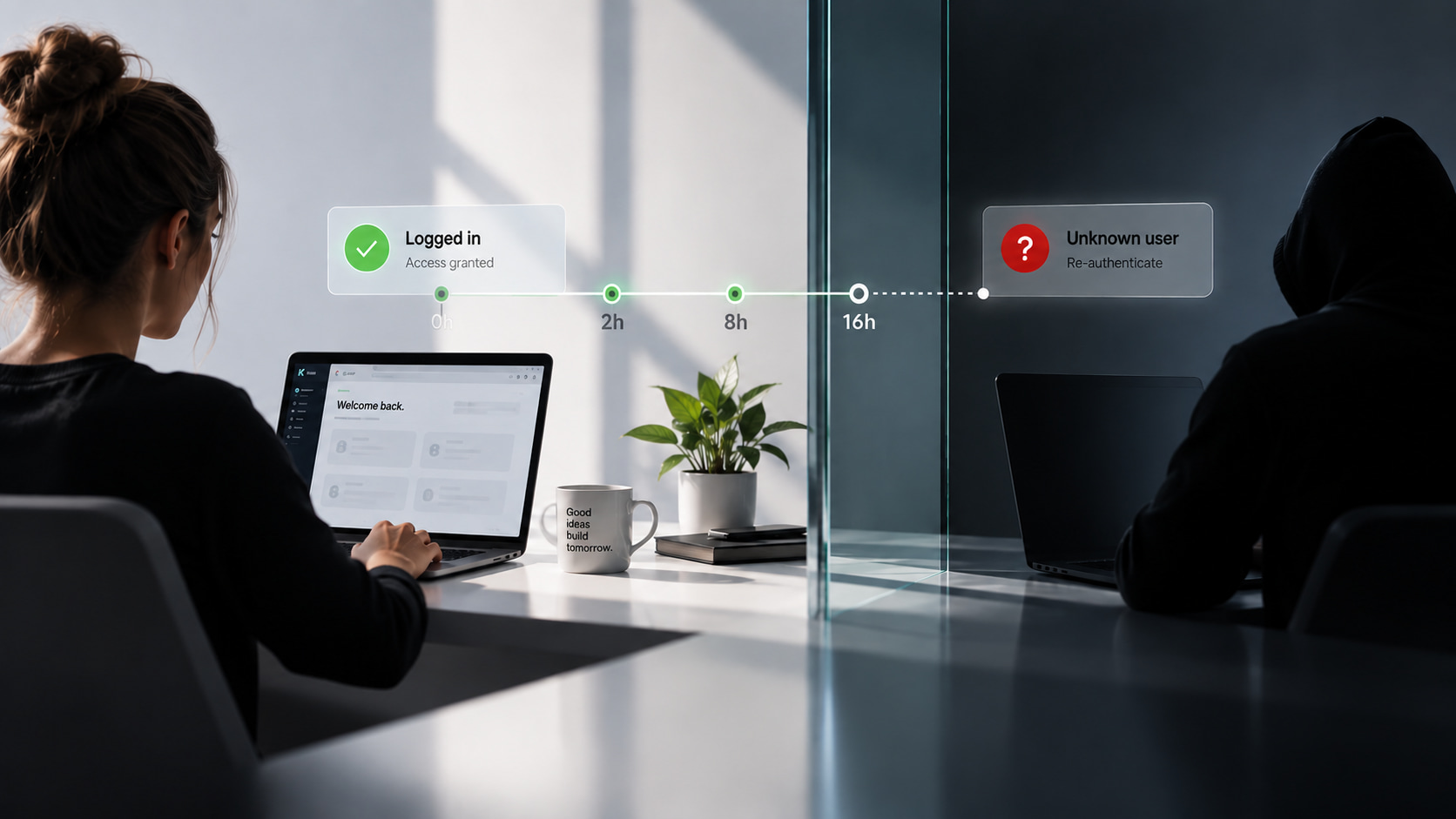
When a user logs into a system, their identity is verified. If their credentials and other authentication mechanisms are valid, the system grants access and creates a session.
But authentication confirms identity at a specific moment in time. The user may then continue working for hours without having to authenticate again.
This raises an important question for software security: how long should a session remain trusted after a user has been authenticated?
Login Is the Beginning of Access, Not the End of Control
After a successful login, the system typically creates a session that allows the user to continue working without entering their credentials for every action.
This is essential for usability. But an active session also represents the continuation of a decision made earlier: the system assumes that the person using the session is still the same person who originally authenticated.
The longer that trust remains in place, the more important it becomes to manage it properly.
NIST addresses this directly as part of session management, defining periodic reauthentication as a way to confirm the continued presence of the user within an authenticated session.
An Active Session Does Not Always Mean the Situation Is the Same
Consider a simple example.
A user logs in at 8:00 AM from their work device. Several hours later, the session is still active. Technically, the system may still have a valid session, but the time that has passed, a period of inactivity, or the context of access may change the level of risk.
This is precisely why mechanisms such as session expiration, inactivity timeout, and reauthentication exist.
NIST distinguishes between two main limits: an overall limit on the duration of a session and a limit on periods of inactivity. Once these limits are reached, the session should end or the user should authenticate again, depending on the system’s policy.
Not Every User and Every Action Carry the Same Level of Risk
One of the challenges of session management is that a single rule is not necessarily appropriate for every situation.
Reading general information and managing critical privileges do not carry the same level of risk. Likewise, a standard user and an administrator with extensive access do not necessarily require the same session policy.
This is why modern access management is becoming more granular. On September 15, 2026, Google Cloud announced the completion of its rollout of a default 16-hour session length for customers who had not configured their own session duration, while new controls allow more specific policies to be applied by group and application. Google gives the example of a two-hour session for highly privileged users compared with a standard 16-hour session for regular developers.
Security and User Experience Need to Work Together
A system could require users to authenticate repeatedly, but this would quickly make it frustrating to use. On the other hand, a session that remains active indefinitely can increase exposure if the device or session falls into someone else’s hands.
The objective, therefore, is not simply to make sessions as short as possible.
It is to determine when it makes sense for the system to continue trusting the existing authentication and when a new verification should be required.
Modern standards treat this as a context-dependent decision, taking into account factors such as the type of application, the device, the environment in which the system is being used, and the required level of security.
Digital Trust Has a Time Dimension
Identity security is often discussed in terms of what happens at login: passwords, MFA, passkeys, and other authentication methods.
But a system also needs to manage what happens after authentication.
How much time has passed? Has the session been inactive? What level of access does the user have? Are they attempting an action that requires a higher level of security?
These decisions make session management part of the access architecture, rather than simply a timer that automatically logs a user out.
At Soft & Solution Group, identity and access management are treated as part of how system security is designed throughout the entire user journey, from initial authentication to ongoing access control.
As Ermal Beqiri, founder of Soft & Solution Group, says:
“Security does not end when a user logs in. A system also needs to know when it is time to verify their identity again. This balance between access and control is part of how a secure system is built.”
A successful login confirms that the system trusted the user at that moment. Session management determines how long that trust remains valid.