
How Are Financial Systems Changing for the Age of AI Agents?
Date: September 18, 2026
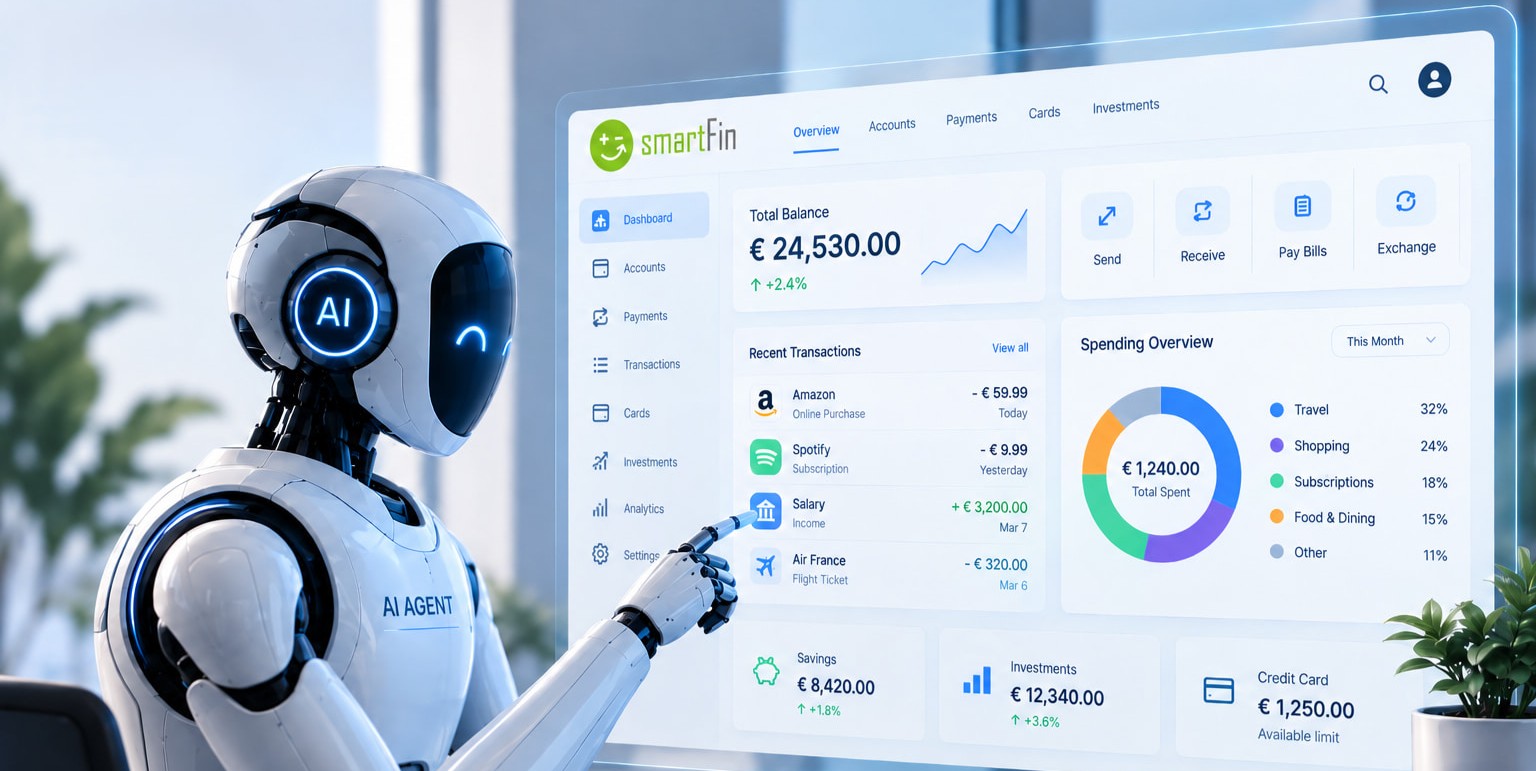
For decades, digital financial systems have been built around a relatively clear logic: a user or an organization gives an instruction, the system authorizes it, and the transaction is executed.
AI Agents are beginning to change this model. An AI system can receive an objective, evaluate alternatives, select a service and, within predefined boundaries, initiate a payment. This means software is no longer simply the tool through which a transaction is carried out. It can become an active part of the decision that leads to it.
This shift is already moving from experimentation to real-world transactions. In July 2026, Visa announced live transactions in Europe in which AI Agents searched for products, made selections and initiated purchases according to parameters defined by users.
From “Pay” to a mandate to act
In a traditional payment, the moment of authorization is relatively visible. The user clicks “Pay,” confirms a transaction or approves a request.
With AI Agents, that moment may occur much earlier.
A user might ask an agent to find a flight within a specific budget and book it if it meets certain conditions. An organization might authorize a system to automatically purchase a cloud service when additional resources are required.
In these cases, the financial system must verify not only who is carrying out the transaction, but also whether the action performed by the AI Agent matches what the user actually authorized.
This is giving rise to a new concept in payment infrastructure: verifiable intent. Mastercard, for example, is developing a mechanism that creates verifiable proof of what a user authorized, giving the merchant, bank and payment network a shared reference for the original intent behind the transaction.
AI can make the decision. The payment still has to follow precise rules
This introduces one of the most interesting challenges for financial system architecture.
AI operates through probability, context and dynamic decision-making. A payment system, on the other hand, must be precise: a transaction is either authorized or it is not, the amount must be defined, and settlement must have a clear outcome.
The IMF describes this as a tension between the probabilistic nature of AI and the deterministic requirements of payment infrastructure. One possible model separates the process into three layers: intent, authorization and settlement. AI can operate at the layer where intent is interpreted and an action is planned, while authorization and financial execution remain governed by verifiable rules.
This separation could become an important element of the next generation of financial platforms: intelligence determines what should be done, while the financial infrastructure determines what is allowed to be done.
Systems need to recognize not only the user, but also the agent
In traditional systems, financial identity is primarily associated with individuals and organizations. In an economy where AI Agents can initiate transactions, another participant emerges that the system must be able to distinguish.
Is the transaction coming directly from the user, or from an agent acting on their behalf? Which user is the agent representing? What authorization has it received? How much can it spend? What is it allowed to spend that amount on? And how long does the authorization remain valid?
Visa is already working with banks and merchants to make transactions initiated by AI Agents distinguishable and authenticatable. Its programs include testing tokenization, authentication and transaction authorization for this new category of payments.
An AI Agent therefore cannot simply be treated as another user of the system. It needs an identity and a mandate that clearly define the boundaries within which it is allowed to act.
Payments could move from human-to-business to machine-to-machine
The shift becomes even more significant when not only the “Pay” click disappears from the equation, but also the traditional purchasing process itself.
An AI Agent may need an API, cloud capacity, data or another digital service. Instead of a person purchasing that service in advance, software could request it, use it and pay for it as needed.
In June 2026, Mastercard introduced Agent Pay for Machines specifically for programmatic and machine-to-machine payments, including very small-value transactions that could take place continuously between systems.
This could change not only how we pay, but also how financial platforms are designed. Systems need to be prepared for transactions that may be initiated in the background by software, at a frequency and speed that are no longer built around human interaction.
Financial architecture is preparing for a new participant
For Soft & Solution Group, the evolution toward agentic payments shows that integrating AI into financial systems is not simply a matter of adding an intelligent model to an existing platform.
The relationship between the AI Agent, identity, authorization, financial rules and the infrastructure that executes the transaction must be designed as part of the system itself.
As Ermal Beqiri, Founder of Soft & Solution Group, explains:
“When software starts taking financial actions on behalf of a user, the system needs to understand not only who is acting, but also what they are authorized to do. AI can bring greater autonomy, but that autonomy must operate within clear boundaries defined by the architecture.”
AI Agents are not only changing the interface through which we interact with financial services. They are introducing a new participant into the payment process itself.
For financial systems, the next challenge will therefore be not only how to execute a transaction, but also how to prove that the software had the authority to make that decision.