
GPT-6.1 Sol Gets Faster: Is AI Latency Becoming an Architectural Challenge?
Date: October 9, 2026
The development of artificial intelligence has primarily focused on the accuracy of responses and the ability of models to solve complex tasks. But as AI becomes integrated into applications, another factor is becoming increasingly important: response time.
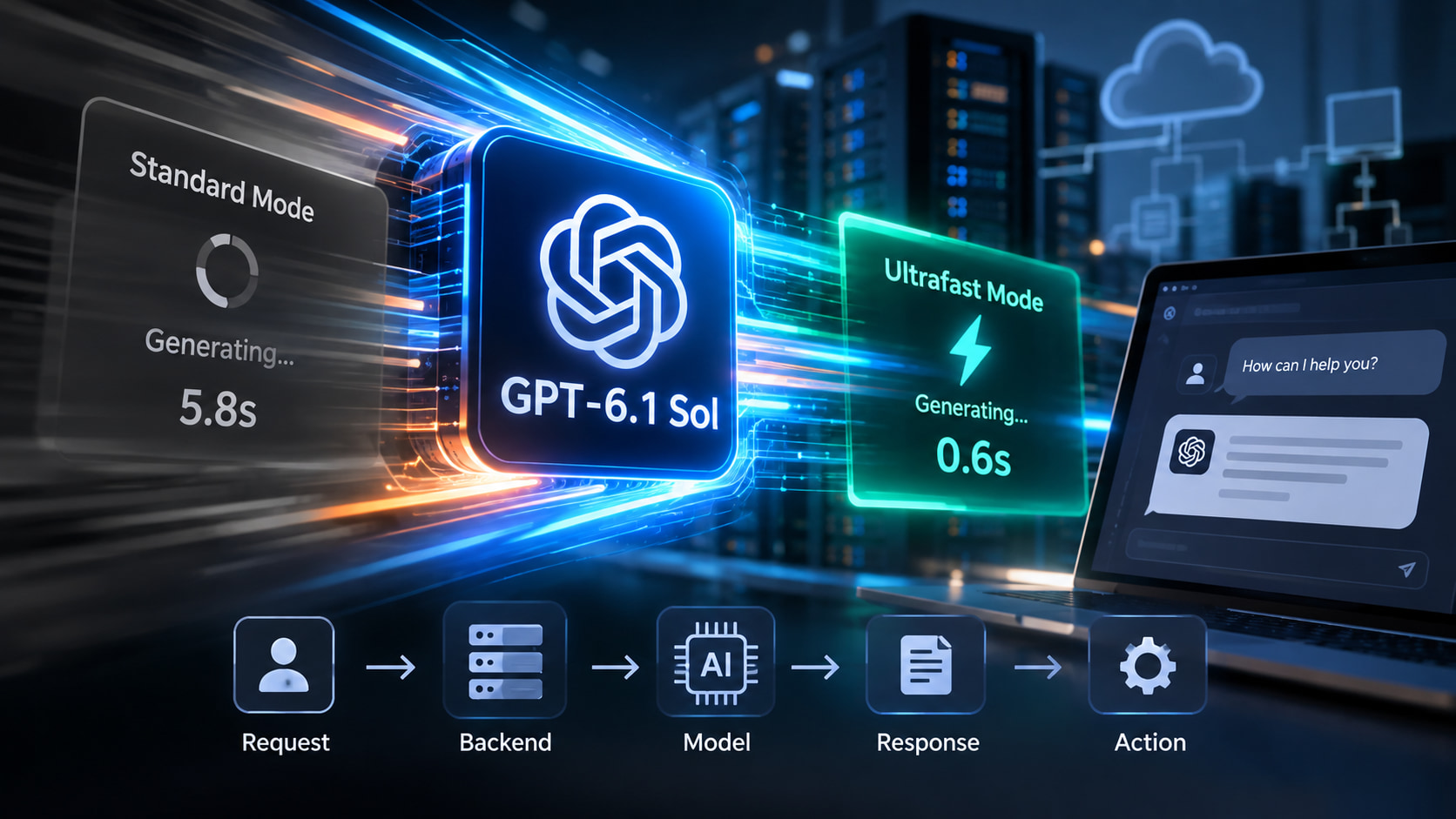
On October 8, 2026, OpenAI introduced Ultrafast mode for GPT-6.1 Sol through the Responses API. This mode aims to accelerate result generation and reduce latency when using the model.
This development raises an important question: is AI performance becoming an element that must be considered from the earliest stages of software architecture?
Why Does AI Speed Matter?
In traditional applications, response time depends on the server, database, network, and the way information is processed.
When AI is integrated, the time required for the model to analyze data and generate a response becomes an additional factor.
For example, a platform that uses AI to classify customer requests may need to wait for the result before continuing the process.
If several requests are executed sequentially, delays accumulate and affect application performance.
Therefore, AI speed is not just a characteristic of the model, but also an important factor in how software operates.
What Changes with Ultrafast for GPT-6.1 Sol?
Ultrafast mode aims to improve the speed of response generation through the API.
It is activated by using the gpt-6.1-sol model and the service_tier: “ultrafast” parameter.
According to OpenAI’s documentation, this mode has specific usage conditions and higher costs than standard processing.
However, faster generation does not automatically guarantee faster completion of every request. Performance also depends on the network, task complexity, and system architecture.
How Does It Affect Software Architecture?
In modern systems, AI can be used to analyze information, classify requests, generate code, or automate processes.
Such a process can be organized as follows:
Request → Backend → AI Model → Response → Action
If the model responds slowly, the entire process may be delayed.
For this reason, developers must determine which tasks require immediate responses and which can be processed asynchronously.
Model selection, API communication, and the organization of backend processes therefore become part of architectural decisions.
Should Every Application Use Ultrafast?
Not every task requires maximum speed.
A system that prepares periodic reports can tolerate longer processing times. Meanwhile, an application that communicates directly with users may require faster responses.
The use of Ultrafast should be evaluated based on cost, complexity, and actual benefits.
The goal is not always to use the fastest model, but to achieve the right balance between speed, accuracy, and cost.
AI Performance and the Future of Software
The introduction of Ultrafast demonstrates that the development of artificial intelligence is not only about the capabilities of models, but also about their performance within real-world applications.
For Soft&Solution Group, this development highlights the importance of architectures in which AI performance is planned from the earliest stages of development.
Developers must analyze what the model can accomplish, how much time it requires, and how it affects other system processes.
In this context, a proposed statement for Ermal Beqiri, founder of Soft&Solution Group, is:
“The integration of AI into software should not be evaluated solely by the quality of its responses. Speed, reliability, and cost are equally important. A well-designed architecture must ensure that artificial intelligence improves application performance rather than creating new obstacles.”
Ultrafast creates new opportunities for applications where response time is critical, but it does not replace the need for software optimization.
The future of AI-powered software development will depend not only on the intelligence of models, but also on the ability of systems to use them quickly, efficiently, and in a controlled manner.