
From Writing Code to Directing Agents: How Is the Role of the Software Developer Changing?
Date: September 22, 2026
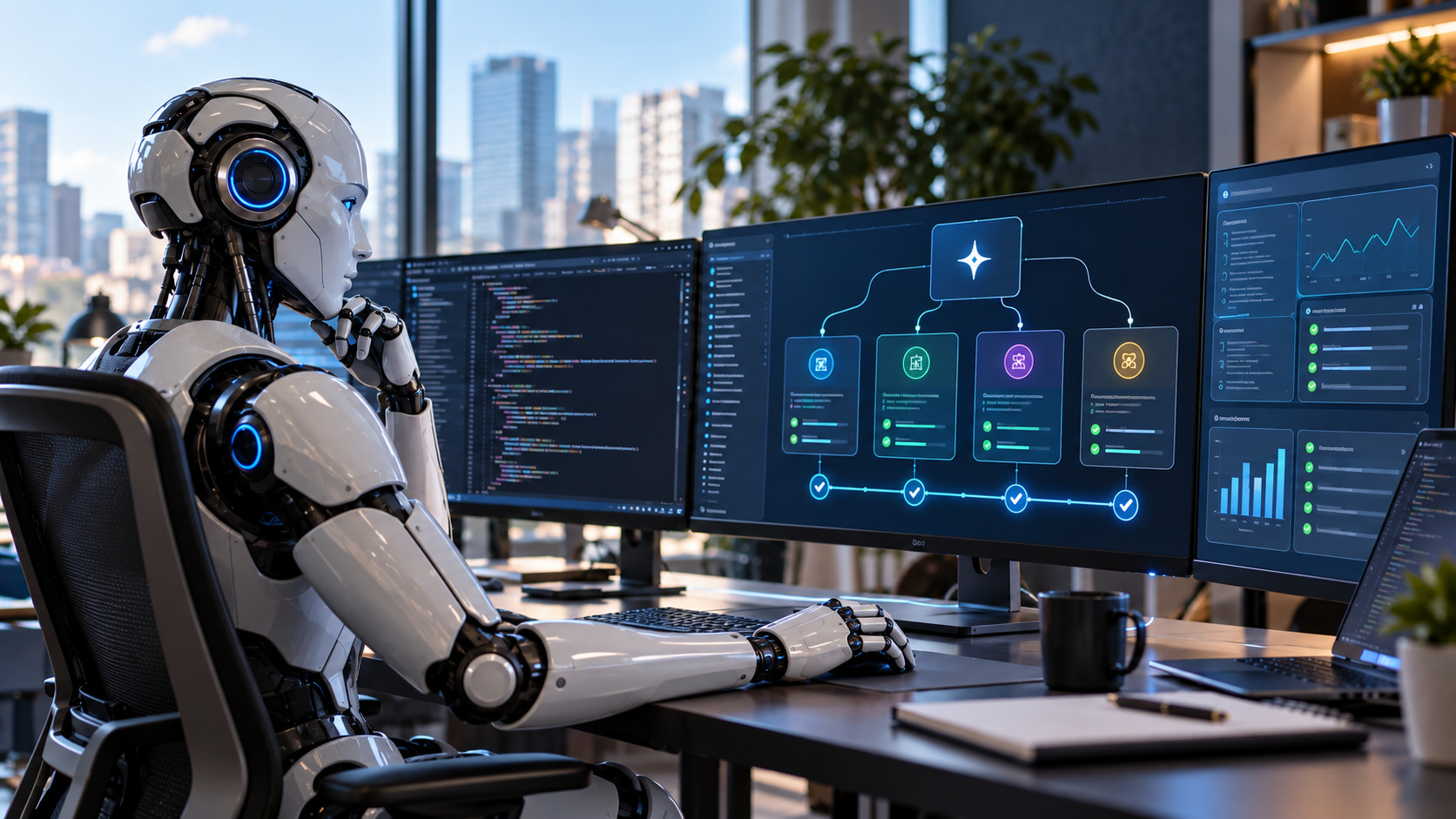
For years, the work of a software developer has been associated primarily with writing code. A developer would receive a requirement, translate it into technical logic, test the solution, and fix any problems that emerged during the process.
With the arrival of AI Coding Agents, this model is beginning to change. Artificial Intelligence tools are no longer used solely to suggest a line of code or automatically complete a function. They can analyze a codebase, plan changes, write code, run tests, and prepare the work for review.
This shift is creating what is now described as agentic development: a new way of building software in which developers do not necessarily carry out every step themselves, but instead direct and supervise agents that execute parts of the process.
From Assistance to Task Delegation
The first AI tools for programming primarily functioned as assistants. They suggested code snippets, explained functions, or helped identify errors. The developer continued to directly control almost every action.
AI Coding Agents are introducing a different model. Instead of asking AI to write only a single function, it can be assigned a broader objective: analyze a problem, identify the files that need to be modified, implement the solution, and verify whether it works.
In this case, the developer is not merely asking for help producing code. They are delegating an entire technical process.
Anthropic’s report on agentic development trends highlights that AI is changing roles within software teams, human–AI collaboration models, and the way multiple agents can be coordinated within the same development process.
The Developer Is Moving from Executor to Process Designer
Agentic development does not remove the developer from the process. Instead, it shifts their attention from the manual execution of every step to designing how the work should be carried out.
Rather than writing every line of code, the developer must clearly define the problem, the boundaries of the task, the standards that must be followed, and the way the result will be evaluated.
This requires a broader set of skills. A developer must understand not only the programming language, but also the system architecture, the dependencies between components, security requirements, and the impact that a change may have on the rest of the application.
The more tasks that are delegated to an AI Agent, the more important the quality of the instructions and context provided to the agent becomes.
Writing Specifications Is Becoming as Important as Writing Code
An AI Coding Agent should not only know which function it needs to create. It must understand why the change is necessary, which constraints it must respect, and how an acceptable result is defined.
For this reason, agentic development increases the importance of technical specifications.
An unclear request may produce code that appears functional but does not meet the actual business need. A clear specification gives the agent the objective, context, acceptance criteria, and boundaries within which it can operate.
The developer’s role is therefore becoming closer to that of a technical architect. They must break down a complex problem into understandable tasks, define the relationships between them, and decide which decisions can be delegated to AI.
AI-Generated Code Must Be Verified, Not Simply Accepted
The fact that an AI Agent can produce code and run tests does not mean that the result should be accepted automatically.
Code may pass the defined tests and still contain architectural problems, security vulnerabilities, or choices that make the system more difficult to maintain. The agent may technically fulfill the requirement without fully understanding the purpose of the product or the long-term impact of the solution.
For this reason, human verification remains an essential part of software development.
The developer must check not only whether the code works, but also whether it is readable, secure, testable, and consistent with the existing architecture. In an agentic process, code review is not simply a syntax check. It becomes the primary mechanism for validating the quality of delegated work.
A Software Team May Include Multiple AI Agents
Agentic development is not necessarily limited to the relationship between one developer and one agent.
A process may include one agent that analyzes requirements, another that implements changes, an agent that generates tests, and another that checks the code for security issues. Each one may have a defined role and use different tools.
Within such an architecture, the developer must determine how tasks are divided, what information the agents exchange, and at which points human approval is required.
This introduces a new form of orchestration. The developer manages not only the components of an application, but also the digital actors involved in building it.
Productivity Is Not Measured Only by the Amount of Code
AI Coding Agents can significantly increase the speed at which code is produced. However, more code does not necessarily mean better software.
If teams generate changes faster than they can review, test, and maintain them, apparent productivity may create technical debt. For this reason, success must be measured through the quality, sustainability, and impact of changes, not only by the number of completed tasks.
In agentic development, the main question is not how much code an AI Agent can produce. The question is whether it can contribute to building a system that is accurate, secure, and maintainable.
Developers’ Skills Are Not Disappearing, but Changing
Knowledge of programming languages, data structures, databases, and software architecture remains essential. Without this knowledge, it becomes difficult to determine whether a solution created by an agent is genuinely good.
What is changing is the way these skills are used.
Developers must be able to formulate precise objectives, provide the necessary context, identify incorrect results, and make decisions when several technical alternatives exist. They must also understand which tasks can be automated and which require human judgment.
In this sense, agentic development does not reduce the importance of technical expertise. It shifts that expertise from the manual production of code toward directing, supervising, and improving automated processes.
Agentic Development Requires a New Model of Accountability
For Soft&Solution Group, the use of AI Coding Agents should not be viewed solely as a way to write code faster. It requires a clear model of accountability for how tasks are assigned, results are reviewed, and changes are approved.
If an agent makes a change to a system, it should be possible to understand what the objective was, what context it was given, which actions it performed, and who approved the result.
As Ermal Beqiri, founder of Soft&Solution Group, explains:
“Agentic development does not remove the developer from the process; it places them in a more strategic role. When AI can write and test code, the developer’s responsibility shifts toward designing the solution, directing the agents, and verifying every result before it becomes part of the system.”
AI Agents are gradually changing the way software is built. The developer is no longer only the person who writes every line of code, but also the person who defines the objectives, organizes the process, and guarantees the quality of the result.
In this new model, a developer’s value is not measured solely by coding speed. It is increasingly connected to the ability to make technical decisions, direct intelligent systems, and turn the work of AI Agents into reliable software.
Agentic development does not make the developer less important. It makes their role broader.