
From Responses to Decisions: How Is Decisions API Changing the Way Applications Use AI?
Date: October 8, 2026
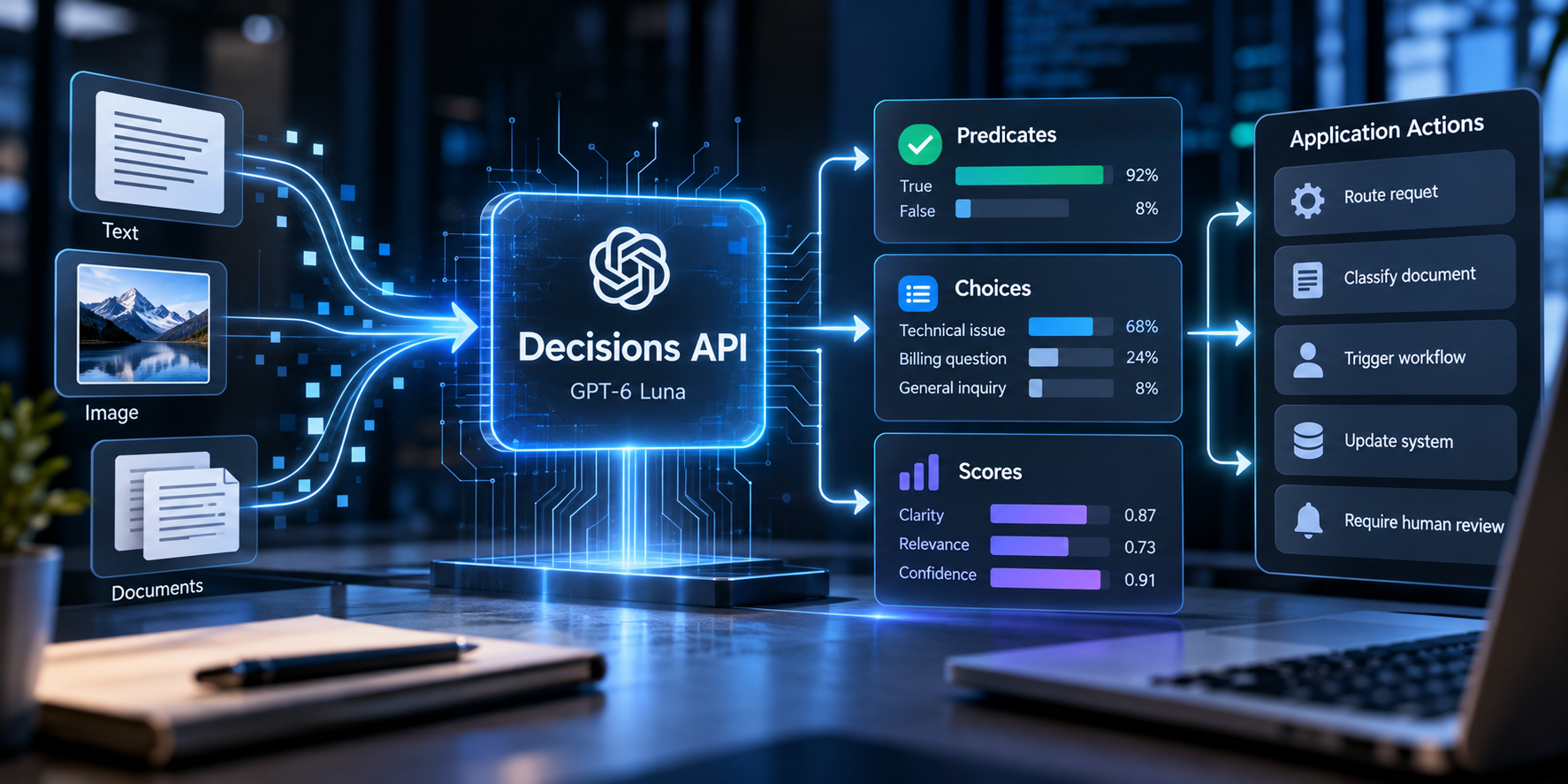
Artificial intelligence has primarily been used to generate text, analyze documents, and create content. But many applications do not need lengthy responses. They need to determine whether a condition has been met, choose between alternatives, or evaluate information.
On October 6, 2026, OpenAI introduced Decisions API, an interface that uses the GPT-6 Luna model to transform text and images into structured results.
This development signals a shift in how AI is used: from generating responses to supporting decision-making within software.
From Textual Responses to Structured Results
In traditional integrations, the AI model generates a response that the application must interpret.
For example, a system that manages customer requests needs to determine whether a message relates to technical support, billing, or a general inquiry.
Decisions API can convert this assessment directly into a structured result, reducing the need to interpret text.
How Does Decisions API Work?
Decisions API is based on three main methods:
Predicates – Evaluating Conditions: Calculates the probability that a statement is true.
Choices – Selecting Between Alternatives: Classifies information by choosing from predefined categories.
Scores – Numerical Evaluation: Provides a numerical result based on specific criteria.
These functions create an evaluation layer that can be integrated with the application’s existing logic.
How Does It Affect Software Architecture?
In traditional applications, decisions are based on rules written by developers. But when information is unstructured, these rules can become complex.
Decisions API can interpret information before the system determines the action.
The process can be organized as follows:
Information → AI Evaluation → Structured Result → Application Rules → Action
For example, AI can classify a document, while the backend decides where it should be stored.
In this way, AI supports interpretation, but the software retains control over actions.
Speed, Cost, and Reliability
According to OpenAI, Decisions API can deliver results up to ten times faster than Responses API for comparable tasks.
During the public beta launch, the company announced a price of $0.10 per one million input tokens, with no separate charge for output tokens.
These characteristics could make the technology useful for applications that perform numerous automated evaluations.
However, a fast result is not necessarily accurate. Developers must establish testing, verification, and human oversight mechanisms for decisions with significant consequences.
Decisions API and the Future of Software Development
Decisions API demonstrates that artificial intelligence is increasingly becoming part of applications’ internal processes, rather than merely a tool for communicating with users.
For Soft&Solution Group, this development highlights the importance of architectures in which AI and traditional logic work together, with clearly defined responsibilities and control mechanisms.
In this context, a proposed statement for Ermal Beqiri, founder of Soft&Solution Group, is:
“The future of AI in software is not only about generating responses, but about integrating it into application logic. AI should help evaluate information, while the system retains control over decisions and actions.”
Decisions API does not replace traditional programming but complements it with an intelligent evaluation layer.
AI interprets information, the application checks the conditions, and the system determines the action.
This approach could lead to more efficient, more automated, and more controllable software.