From Manual Processes to a Single Platform: How Can a Business Go Digital?
Date: September 7, 2026
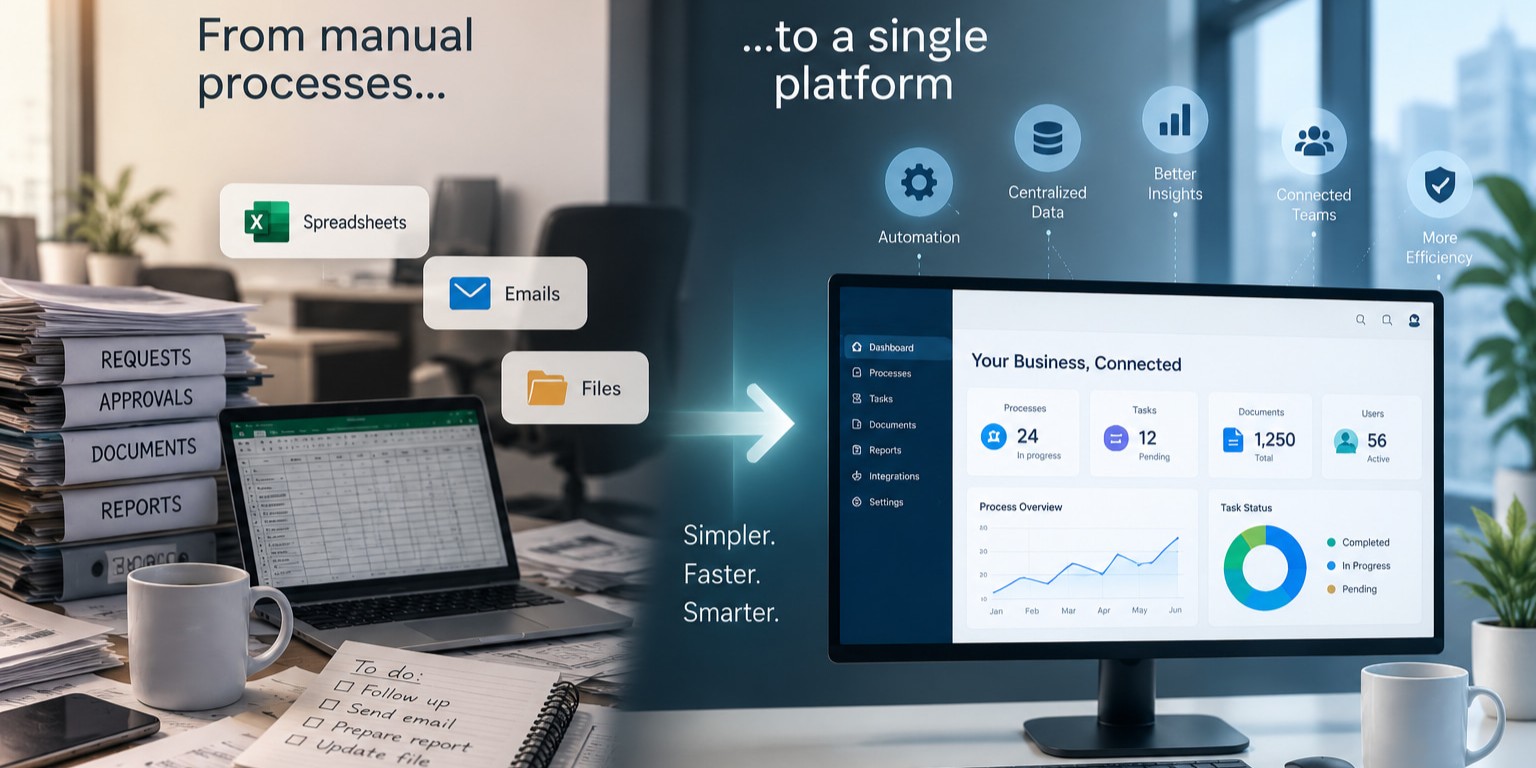
Many businesses do not immediately recognize the point at which their day-to-day processes have become more complex than the tools they use to manage them.
One department works with spreadsheets, another manages requests through email, documents are stored in different locations, and reports are prepared manually by gathering information from multiple sources.
Each of these tools may work perfectly well on its own. The challenge begins as the business grows and more processes, people, and data need to be coordinated.
At this point, digitalization is not simply about moving from paper to a computer. It is about organizing business processes so that information is centralized, work flows more efficiently, and technology supports the way the company operates.
When manual processes start costing time
Consider a common approval process.
A request is sent by email. Someone needs to review it, forward it to the person responsible, and then wait for a response. The final document is saved in a folder, while the status of the request may be tracked in a spreadsheet.
The process works, but as the number of requests grows, it becomes increasingly difficult to know where each one stands, who needs to take action, and how long the process is taking.
A software platform can bring this entire workflow into one place. The request is registered, automatically routed to the right person, its status is updated, and the information remains accessible without having to search through multiple emails or documents.
A single platform does not necessarily mean replacing everything
Digitalization does not always require a business to abandon the systems it already uses.
A company may have financial software, a CRM, document management systems, internal applications, or other services that remain essential to its operations.
In this case, the role of a centralized platform can be to integrate these systems, allowing information to move between them without having to be entered manually multiple times.
The goal, therefore, is not to build software simply for the sake of having a new system. It is to create a more organized way of managing the processes the business actually needs.
From scattered data to information you can use
When information is spread across spreadsheets, emails, documents, and different systems, even a simple question can take time to answer.
How many requests are currently in progress? How long does an approval take on average? Where are delays occurring? What is the current status of a project?
When processes are managed through a shared platform, data is created and updated as the work happens. This makes it easier to generate reports, monitor performance, and make decisions based on up-to-date information.
In this way, digitalization does more than automate tasks. It also provides greater visibility into how the business operates.
Software should adapt to the business, not the other way around
Every company has its own way of working. That is why not every process can be addressed with the same standard platform.
In some cases, an existing solution is more than sufficient. In others, specific processes, the number of users, integration requirements, or reporting needs may make a custom software solution the better option.
The starting point should always be the process itself: what needs to improve, what can be automated, which systems need to communicate, and what information the business needs to operate more effectively.
As Ermal Beqiri, founder of Soft & Solution Group, explains:
“As a business grows, the way it works needs to evolve too. Instead of adding more spreadsheets, emails, and manual steps, we can connect processes within a single platform, automate repetitive work, and make information easier to access and use.”
For a business, moving toward digitalization does not necessarily require transforming everything at once. It can begin with the processes that involve the most manual work and gradually evolve into a more integrated, manageable system that is better equipped to support the company’s growth.