
From Connectivity to Physical Security: How 5G and 6G Networks Could Help Detect Drones and Infrastructure Threats
Date: November 17, 2026
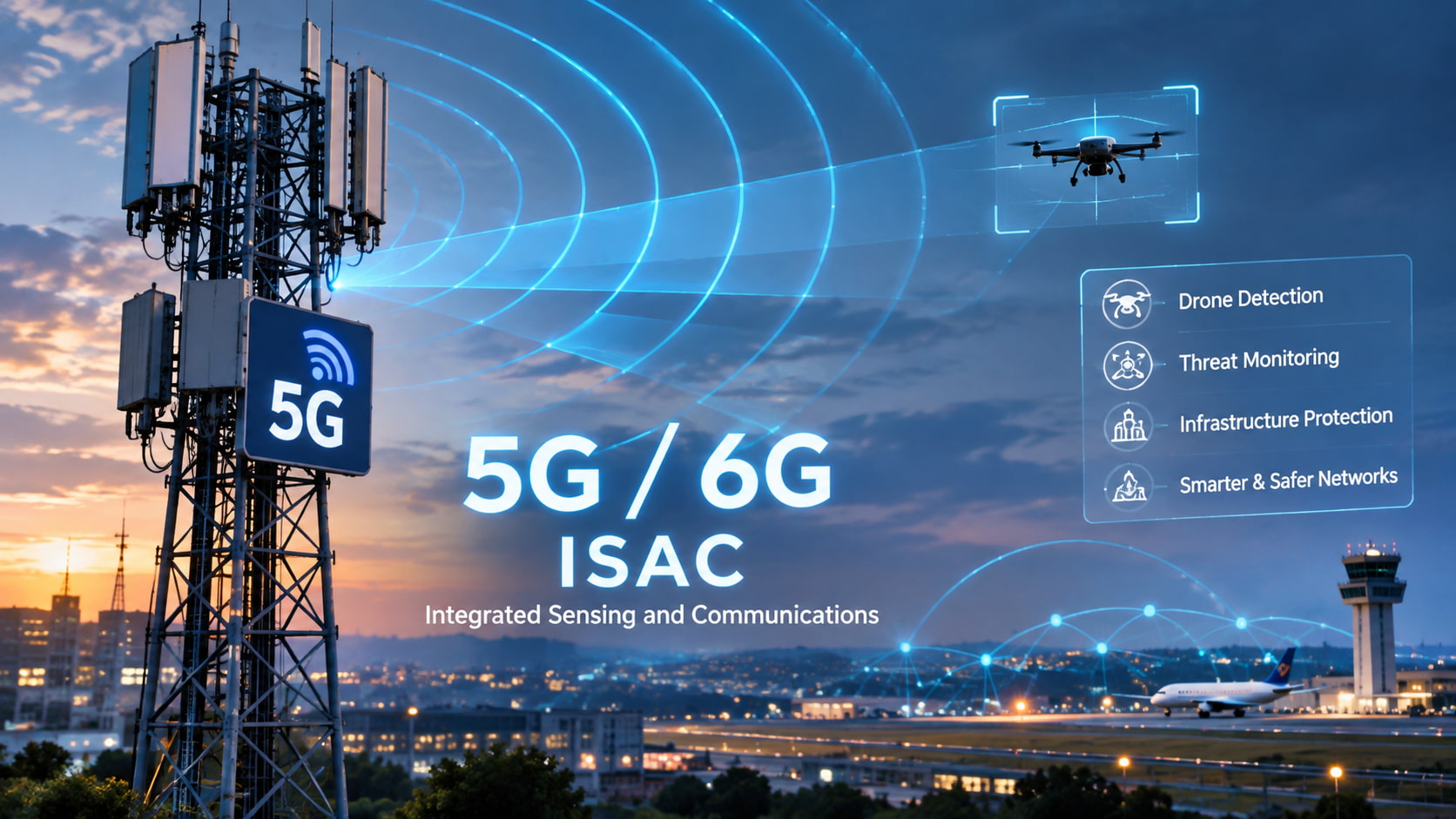
Small, low-cost drones are creating new security challenges for airports, ports, power facilities, industrial sites, transport corridors, and other critical infrastructure. Cameras, radar, and dedicated sensors remain essential, but monitoring wide areas and detecting low-flying objects can require additional layers of awareness.
A developing approach explores whether cellular networks can do more than carry voice and data. Through Integrated Sensing and Communications (ISAC), wireless infrastructure may also help detect and track physical objects by analysing how radio signals interact with the surrounding environment.
On November 13, 2026, Nokia Federal Solutions announced a contract under the U.S. Department of War’s RAPID project to develop, build, and test ISAC capabilities. The project aims to demonstrate how 5G and future 6G infrastructure could improve threat detection and situational awareness, particularly for critical infrastructure protection. It is a prototyping and demonstration effort, not an announcement that a fully deployed commercial system is already available.
Source: Nokia Federal Solutions, “Nokia Federal Solutions awarded Department of War RAPID contract to advance multi-domain threat awareness”, November 13, 2026.
What is ISAC and how does it work?
In a conventional mobile network, radio sites transmit signals to connect phones and other devices. ISAC adds a sensing function: the network analyses how radio waves are reflected by objects in the environment. By processing these reflections, the system can estimate the presence, position, and movement of an object.
Rather than relying on a single sensor at one location, a distributed system can use several mobile-network sites that observe signals from different angles. Combining those measurements may improve tracking continuity and positioning. Edge computing, artificial intelligence, and signal-processing techniques can help classify objects and interpret the resulting data.
This does not mean that every 5G antenna is already a radar or that 6G is ready for broad commercial deployment. ISAC requires specialised capabilities, suitable spectrum and radio configurations, algorithms, and field testing. 5G can provide an early technical foundation, while more integrated sensing and communications capabilities are expected to evolve further toward 6G.
How could networks detect connected and autonomous drones?
There are two complementary detection paths. Drones connected to a mobile network may be identified through network registration, device identity, and unusual communication patterns, subject to applicable permissions and rules. This can help identify suspicious activity by drones that use cellular connectivity.
Drones that are not connected to the network present a different challenge. They may not use a SIM card or may rely on a separate radio link. ISAC aims to help detect these objects by analysing reflections from cellular signals, without requiring the drone itself to be registered on the network.
The distinction matters: identifying a connected device and sensing the physical presence of an object are different processes. Neither one automatically proves that the object is hostile. Sensing information needs to be assessed alongside other evidence and authorised response procedures.
What are telecom companies testing?
Nokia Federal’s RAPID project will build and test an end-to-end demonstration based on Nokia’s AI-RAN platform. The company says the work will integrate Nokia and third-party applications, multiple sensing modalities, and sensor fusion to create a more comprehensive picture of potential unmanned aerial vehicle threats. The project’s supporting organisations include Texas Tech University, DeepSig, Hidden Level, and Future Technologies.
Ericsson announced its own ISAC System on November 2, 2026. The company says its testing has demonstrated detection and tracking of micro-drones over kilometre-scale distances, with 3D positioning. Ericsson expects selected small-scale, sensing-only commercial pilots to begin in 2027, followed by wider deployments from 2028. These are company-stated plans, not a guarantee that the service will be available in every market on those dates.
Source: Ericsson, “Ericsson brings drone detection capabilities to mobile networks”, November 2, 2026.
Where could the technology be used?
ISAC-enabled networks could provide an additional monitoring layer around airports, seaports, transport corridors, power plants, industrial facilities, borders, and large public venues. For infrastructure operators, information about the movement of objects could help security teams understand more quickly where unusual activity is taking place.
In industrial environments, similar sensing capabilities may also support monitoring of traffic, restricted areas, or other activity in low-altitude airspace. A potential advantage is the ability to use existing telecommunications infrastructure, adding sensing capabilities in locations where installing new dedicated sensors could be costly or complex.
Benefits and limitations businesses should understand
Potential benefits include wider-area coverage, continuous tracking from multiple sites, integration with security operations centres, and more efficient use of existing network assets. Sensor fusion can combine ISAC data with radar, cameras, acoustic sensors, and other systems to build a more complete operational picture.
However, ISAC should not be treated as a replacement for radar or dedicated counter-drone systems. Performance may depend on terrain, buildings, weather, antenna configuration, target characteristics, interference, and network density. Systems need to be evaluated for detection accuracy, false-alarm rates, tracking continuity, and their ability to distinguish drones from other objects.
Detection is not the same as identifying the drone operator or neutralising the aircraft. Any operational response must follow legal procedures, appropriate authorisations, and verification by responsible personnel. Data collection and processing through mobile networks must also respect privacy, radio-spectrum rules, and cybersecurity requirements.
What should businesses and infrastructure operators do?
The first step is to assess risk by site and function: which areas need monitoring, what types of drone activity create a risk, and which existing systems can help verify an alert. Organisations can then engage telecommunications providers and security vendors to understand coverage, technical constraints, integration options, and costs.
A pilot should have measurable objectives, including detection accuracy, time from detection to alert, area covered, false-alarm rate, tracking continuity, and integration with the security operations centre. The technology should be tested in realistic conditions and combined with cameras, radar, or other sensors wherever the risk assessment requires them.
For organisations operating critical infrastructure, governance is as important as the technology itself. They need clear rules covering who can access the data, how long it is retained, how it may be shared with authorities, and who is responsible for deciding how to respond. These rules should be established before the system becomes part of daily operations.
Conclusion: cellular networks are gaining a new role
The developments announced by Nokia Federal and Ericsson show how 5G networks and research toward 6G could gradually become an additional layer for sensing the physical environment. Through ISAC, infrastructure that already carries data may also help detect and track objects, including drones flying at low altitudes.
For businesses, this creates new possibilities for protecting assets and supporting operational continuity, but it also requires realistic expectations, testing, and integration with existing security systems. Soft & Solution Group sees this as an example of telecommunications infrastructure evolving from a communications platform into a broader component of intelligence and security.
As Ermal Beqiri, founder of Soft & Solution Group, explains:
“The networks of the future will not only connect people and devices; they will also help businesses and institutions gain a clearer understanding of what is happening around their critical infrastructure.”