
Feature Flags: How Does Software Change Without Waiting for the Next Version?
Date: August 21, 2026
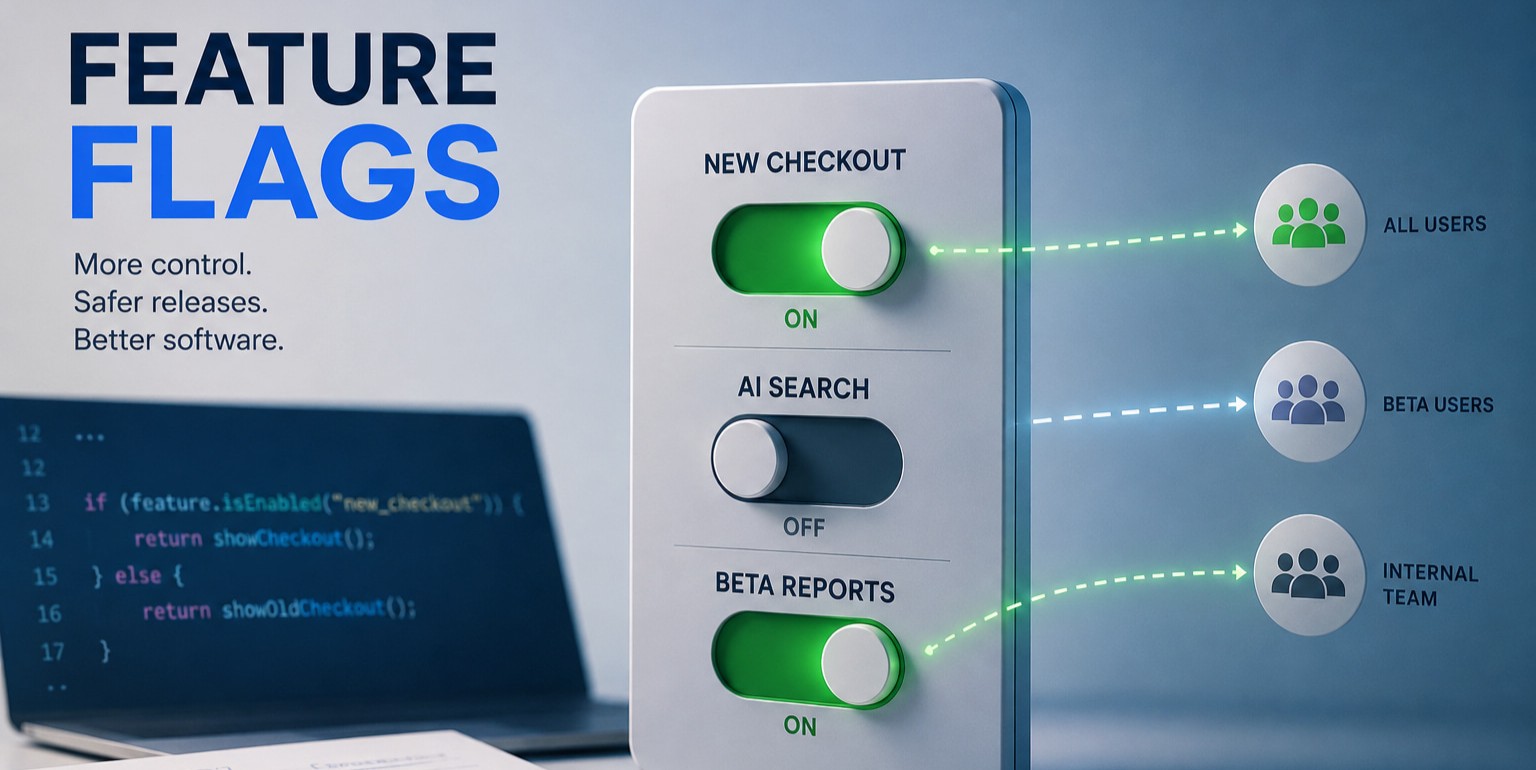
We are used to seeing a new feature arrive with a new version of the software. The application is updated, the version is released, and the change becomes available.
But modern software does not always work this way.
A feature may already be part of the version running in production and still not be active. It can first be enabled only for the team developing it, then for a small group of users, and finally for everyone.
And if a problem arises, it can be disabled without always having to immediately release another version.
Behind this flexibility is a mechanism called Feature Flags.
The code can be ready. The release can wait.
The basic idea is relatively simple.
A Feature Flag acts as a layer of control over a specific feature. The code may already be deployed to production, but the flag determines whether the feature should be active or not.
This separates two moments that have traditionally been closely linked: deploying the code to production and releasing the feature to users.
For development teams, this creates greater flexibility. A new version does not necessarily have to wait until every feature within it is ready to be made available to everyone.
And a feature does not necessarily have to wait for the next version simply because the timing of its release has changed.
Not every change needs to reach everyone immediately
One of the most practical uses of Feature Flags is gradual activation.
A new feature can first be enabled for the internal team. Then for a limited number of users and, if everything works as expected, gradually for a larger group.
This gives the team the opportunity to see how the feature performs under real-world conditions without immediately exposing every user to the change.
Instead of the release being an immediate move from 0% to 100%, it can become a controlled process.
A problem does not always have to mean another version
The same control also works in the opposite direction.
If a problem appears after activation, a feature managed through Feature Flags can, where appropriate, be disabled without waiting for a new release cycle.
The code remains in place, but users are no longer exposed to the problematic feature.
This does not replace testing, rollback, or other software safety practices. But it provides an additional way to respond quickly and limit the impact of a problem.
From releasing versions to controlling changes
Feature Flags do not eliminate releases or the need for new versions. They change the way a feature moves from code to the user.
The team can deploy the code to production and then separately control when the feature is activated, who receives it, and how gradually it becomes available.
As Ermal Beqiri, founder of Soft & Solution Group, says:
“With Feature Flags, a feature can be ready and already part of the software without having to be activated for everyone immediately. This gives teams greater control over how changes are released and the ability to respond quickly if something does not work as expected.”
Software can evolve gradually, while the team maintains control over every step of the change.