
Digital Education Platforms as Infrastructure for a More Organized Education System
Date: May 18, 2026
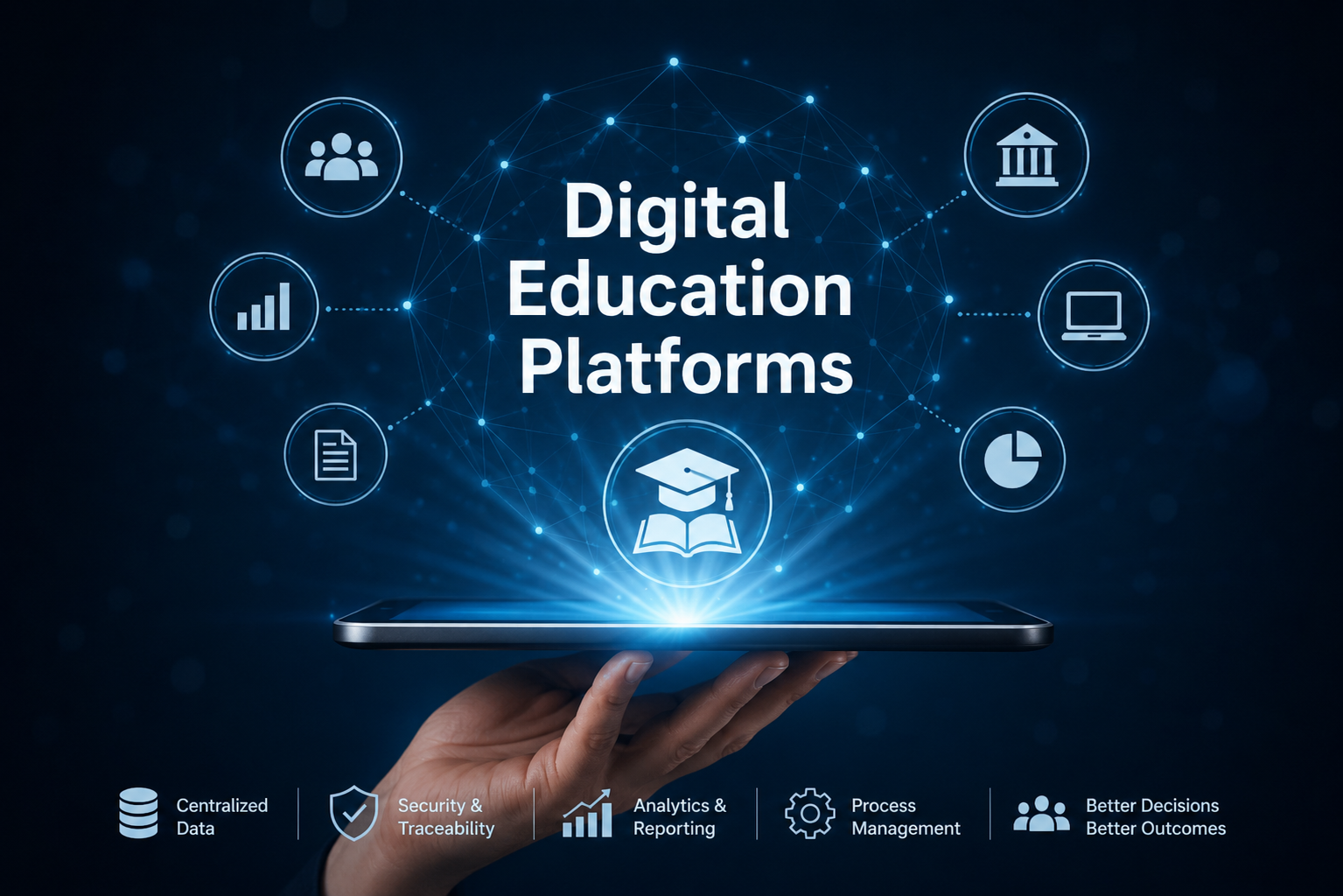
Digital Education Platforms are becoming an important part of how the education system is managed. Their role is not only related to the use of technology in education, but to how data, processes, and reporting are organized to support the daily functioning of educational institutions.
In a system that includes pupils, students, teachers, institutions, programs, registrations, and reports, information management requires a clear structure. Digital platforms help ensure that this data does not remain scattered across different documents or processes, but is managed within a more controlled and traceable system.
Managing education data in a centralized system
One of the main functions of digital education platforms is data centralization. Instead of storing information in separate documents, different spreadsheets, or manual processes, the platform creates a shared environment where data can be registered, updated, and controlled more easily.
This helps institutions gain a clearer view of the information they use every day, including registrations, profiles, statuses, history, and administrative processes.
Better traceability and control
In education systems, data accuracy is essential. Every change, update, or access point needs to be controlled, especially when dealing with data related to individuals, institutions, and official processes.
Digital Education Platforms help create a clearer workflow, where it becomes possible to track what has changed, when it changed, and who made the change. This increases transparency, reduces errors, and makes administration more secure.
Faster reporting and clearer decision-making
When data is organized within a digital system, reporting becomes simpler and faster. Institutions can access information more efficiently, follow important indicators, and support decision-making with more accurate data.
This is especially important in education systems, where administrative and institutional decisions depend on updated and reliable information.
Fewer manual processes, more operational control
Digital platforms help reduce dependence on manual processes. This does not only mean fewer documents, but also less room for errors, delays, or uncertainty in administration.
When processes are standardized within a platform, work becomes more organized and easier to follow. This creates more operational control for institutions and greater consistency in how the system functions.
Platforms as part of education infrastructure
Digital Education Platforms should not be seen simply as technical tools. They are part of the infrastructure that helps the education system operate with greater clarity, accuracy, and responsibility.
In the experience of Soft & Solution Group, digital systems create value when they support real processes, preserve data accuracy, and ensure continuity in daily operations.
An approach based on accurate data
As Ermal Beqiri, founder of Soft & Solution Group, explains:
“Digital Education Platforms should not be seen simply as systems where information is stored, but as structures that bring order, traceability, and reliability to the way education is managed. When data is accurate, controlled, and available on time, decision-making becomes clearer and more responsible.”
Digital Education Platforms help create a more organized education system, where data is managed more effectively, processes become clearer, and decision-making is supported by more reliable information.