
Custom vs. Ready-Made Software for Your Business
Date: October 23, 2026
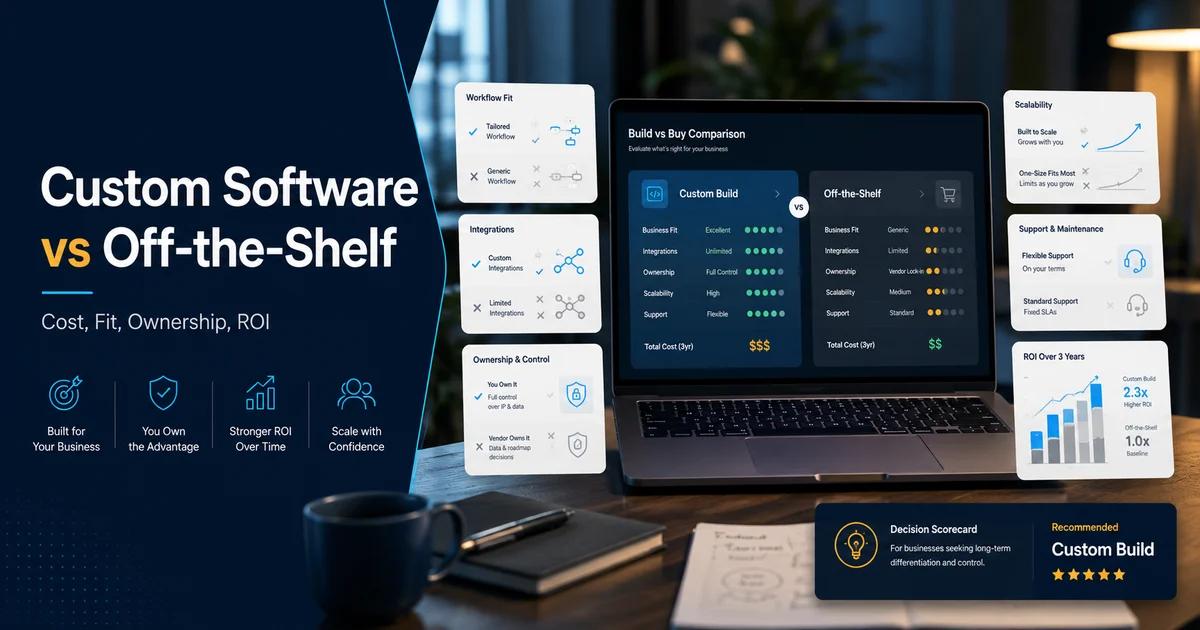
Choosing software for a business is not simply a matter of buying a program or building one. The right decision depends on how the company operates, the problems it needs to solve, and the needs it may have in the future. In 2026, both custom software and off-the-shelf products can improve efficiency, but they serve different priorities.
Off-the-shelf software is built for a broad market and can usually be deployed quickly. It may offer established features, documentation, support, and predictable subscriptions. Custom software is developed around an organisation’s specific processes, rules, users, and integrations. It can provide a closer fit, but requires more planning and initial commitment.
For businesses weighing these options, Soft & Solution Group recommends starting with real needs rather than price or trends alone. When the problem is clearly defined, it becomes easier to compare total cost, usability, security, and long-term value.
When is off-the-shelf software a good fit?
Off-the-shelf products are practical when a company’s needs are common and well covered by existing tools. Accounting, email, collaboration, project management, and basic customer relationship systems often provide useful functionality without a lengthy development process. Teams can get started quickly and benefit from vendor updates.
The trade-off is that the organisation may need to adapt its processes to the product. Subscriptions can become more expensive as users or features are added, while integrations and customisation may be limited. Data export, service availability, and potential price changes should also be reviewed.
When does custom software make more sense?
Custom development is worth considering when a business has specialised processes, complex integrations, or requirements that standard products do not adequately support. A tailored system can connect different workflows, reduce manual work, and create an experience built around employees’ real tasks.
It gives the company more control over future development. However, the budget should include analysis, design, development, testing, hosting, maintenance, security updates, and later improvements. Custom software is not automatically cheaper; its value depends on the problem it solves.
How should you compare the real costs?
Compare the total cost of ownership over a realistic period, not just the initial price. For off-the-shelf software, include subscriptions, add-ons, training, integration, and process adjustments. For custom software, include development, infrastructure, support, maintenance, and internal project-management time.
Assess benefits through measurable outcomes: fewer hours of manual work, fewer errors, faster service, better reporting, or stronger customer retention. Forecast savings should be verified rather than treated as guaranteed. A pilot can test value before a larger commitment.
Questions to ask before deciding
Define essential requirements and separate them from features that would simply be nice to have. Check whether existing products meet those requirements, how easily they connect to current systems, and whether they can scale with the business. Ask about data ownership, access controls, backups, and support.
If you choose custom development, define success criteria, responsibilities, deadlines, and a maintenance plan from the start. If you choose an off-the-shelf product, test it with real users and representative data before entering a long-term contract.
Conclusion: choose what fits your business
There is no universal winner between custom and off-the-shelf software. Standard products can be ideal for common needs and quick deployment. Custom development may be more suitable when processes are distinctive or existing tools create persistent obstacles. The best decision balances fit, cost, risk, and room to grow.
As Ermal Beqiri, founder of Soft & Solution Group, states:
“The best software decision is the one that solves a real problem today while leaving room for tomorrow’s growth.”
A careful assessment of business needs helps organisations choose technology that supports long-term development.