
Code That Consumes Less: Is Energy Efficiency Becoming the New Software Standard?
Date: October 2, 2026
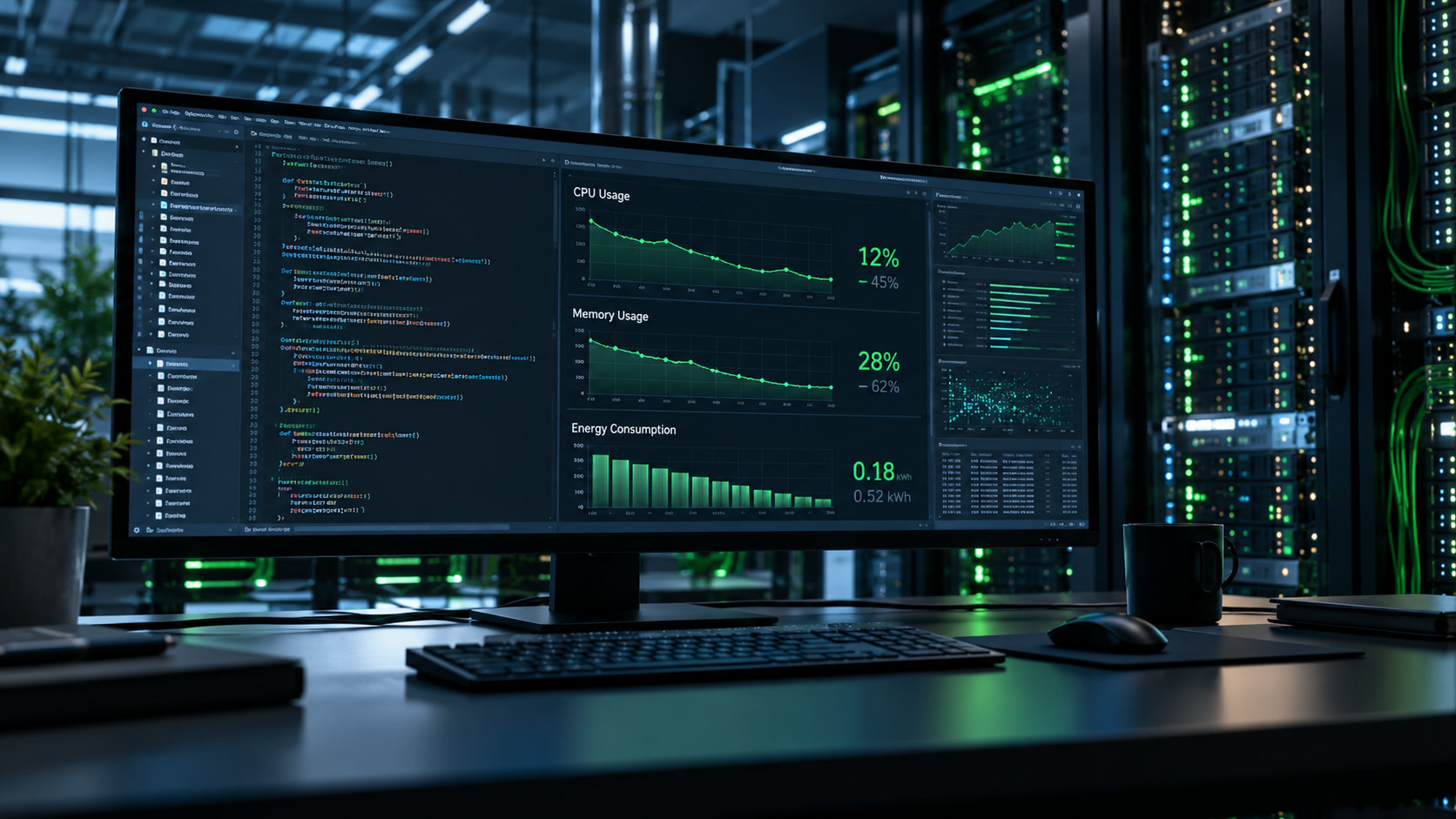
For many years, software quality has been measured primarily through functionality, security, speed, and reliability. An application was considered good if it performed its task correctly, responded quickly, and could handle a growing number of users.
However, every action performed by a digital system requires resources. The processor executes instructions, memory stores data, servers process requests, and networks transport information. The more resources an application uses, the greater the infrastructure and energy that may be required for it to operate.
This is introducing a new criterion into software development: energy efficiency.
A study conducted by GitHub and the Yale Program on Climate Change Communication involving 1,039 GitHub users found that 80% of respondents were interested in tools that help them write more energy-efficient code. At the same time, 78% wanted best practices for reducing software’s environmental impact, while 74% were interested in concrete ways to measure that impact.
These results show that the interest already exists. The challenge is turning it into a measurable and repeatable part of the development process.
Software efficiency begins with resource usage
Software does not consume energy directly in the same way as a physical device. It determines how much work the infrastructure on which it runs must perform.
An algorithm that repeats the same calculation several times uses more processing capacity. An application that retrieves more data than it needs increases database and network usage. A page that loads unnecessary images, videos, or components requires more data transfer and more work from the user’s device.
In small systems, these differences may appear insignificant. However, when an application is used by thousands or millions of people, even a small and inefficient operation can be repeated on a very large scale.
For this reason, energy-efficient software does not begin only with data centers or the source of electricity. It also begins with the decisions made while designing and writing the code.
Faster code is not automatically more sustainable
Speed and energy efficiency are often related, but they are not the same thing.
A function that finishes more quickly may use less processor time. However, a faster solution may require more memory, additional hardware, or more intensive parallel processing. In this case, execution time decreases, but overall resource usage may not.
The infrastructure on which the software runs also affects the outcome. The same workload can have different energy characteristics depending on the hardware, the location of the data center, the time of execution, and the source of electricity.
Therefore, an improvement should not automatically be described as more environmentally friendly simply because the code is faster. The claim must be supported by measurements connected to the specific change.
This is why the development of energy-efficient software requires not only optimization but also evidence.
Measurement must become part of the development process
A software team cannot reliably improve what it is unable to measure.
Before an optimization is introduced, the initial state must be established. This may include execution time, processor usage, memory consumption, the number of database requests, or the amount of data transferred over the network.
After the change, the same measurements must be repeated under comparable conditions. In this way, the team can understand whether the optimization produced a real improvement and what trade-offs it introduced.
For example, replacing an inefficient search operation with a more suitable data structure may reduce processing time. However, if the new solution uses more memory, that change must be documented and evaluated.
A pull request focused on efficiency should show what problem was identified, which metrics were used, what the initial result was, and what changed after the intervention.
In this way, efficiency does not remain a general statement. It becomes a technical result that can be verified.
Inefficiency can be hidden in several parts of the system
Unnecessary resource consumption is not caused only by complex algorithms. It can appear throughout an application’s architecture.
In the code, problems may be related to repeated calculations, inefficient loops, unnecessary object creation, or processes whose results could be cached and reused.
In the data layer, the application may retrieve more information than it needs, execute unbounded queries, or contact the database several times for data that could have been retrieved together.
In network communication, inefficiency may result from duplicate requests, continuous polling for changes, a lack of compression, or the transfer of files that are larger than the user needs.
Even the frontend may use resources unnecessarily through repeated rendering, the premature loading of elements that are not displayed on the screen, or the use of heavy media formats.
This means that energy efficiency is not the responsibility of a single component. It must be evaluated across the entire system flow.
Cloud infrastructure does not automatically solve the problem
Moving to the cloud can help organizations use more flexible infrastructure and adjust capacity according to workload. However, the cloud does not automatically make an application efficient.
If a service performs unnecessary calculations, stores data that is not used, or keeps resources active without a workload, the problem continues to exist. It is simply moved from local infrastructure to the cloud provider’s infrastructure.
The architecture should be designed so that resources are activated when needed and reduced when they are not being used. Scheduled processes should run at the appropriate frequency, while testing environments should not remain active without a reason.
Efficiency can simultaneously reduce infrastructure usage, system latency, and operational costs. For this reason, Green Software should not be viewed only as an environmental initiative. It can also be a sound economic and architectural practice.
The development process also uses energy
Attention is usually focused on the final application, but the process of building and distributing it also uses resources.
Every build, automated test, security scan, and deployment process requires computing power. If a small change continuously activates the entire test suite, or if several pipelines perform the same work, the team may be using more resources than necessary.
Improving CI/CD processes may include caching intermediate results, running only the tests related to a particular change, eliminating duplicate jobs, and disabling processes that no longer provide value.
This does not mean reducing the checks that guarantee quality and security. The objective is to achieve the same guarantees with less unnecessary work.
AI can identify inefficiency, but it should not make the final decision
In large repositories, manually identifying every opportunity for optimization can require considerable time. AI agents can be used to analyze code, data, network communication, and the frontend, highlighting operations that could be optimized.
GitHub has published an experimental workflow that searches for opportunities to improve efficiency, runs tests, and can prepare draft pull requests accompanied by measurements and possible trade-offs. However, the changes are not automatically merged into the main codebase; they are presented to maintainers for review.
This distinction is important. AI can identify a section of code that appears inefficient, but it does not always understand the full business context or the architectural reasoning behind it.
An optimization may improve performance while simultaneously making the code more complex. It may reduce processor usage but increase memory consumption. It may work well in testing but behave differently under real-world workloads.
For this reason, every AI recommendation should be treated as a hypothesis that must be tested, not as a decision that should be implemented automatically.
Efficiency must become an architectural criterion
The decisions with the greatest impact are usually made before most of the code is written.
The way services are divided, where data is stored, how components communicate, and which processes run in real time determine the amount of resources the system will require throughout its lifecycle.
If efficiency is considered only after the product has been completed, the scope for change may be limited. Later interventions may require components to be rewritten or the architecture to be modified.
For this reason, requirements for energy-efficient software should be included in specifications, acceptance criteria, and architectural decisions. The team should define which resources are important to measure and what level of usage is considered acceptable.
Efficiency therefore becomes part of how the system is designed, rather than an optimization added at the end.
Efficient software requires evidence, not only claims
For Soft&Solution Group, software energy efficiency should be treated as an engineering problem that requires verifiable data.
It is not enough for a team to describe an application as sustainable or environmentally friendly. It must be clear what was measured, what was improved, and what limitations apply to the assessment.
As Ermal Beqiri, founder of Soft&Solution Group, states:
“Efficient software is not built simply by writing faster code. It requires us to understand where resources are being used, measure the impact of every change, and choose an architecture that achieves the same objective with less unnecessary work. Only then does energy efficiency become a genuine engineering standard.”
Software development is entering a phase in which functionality and performance are no longer the only criteria. Teams are beginning to assess how many resources a system requires to fulfil its purpose.
This does not mean that every application must be optimized down to the smallest technical detail. It means that the unnecessary use of processors, memory, networks, and infrastructure should become visible and measurable.
If efficiency measurement is integrated into testing, code review, and architectural decisions, resource consumption can be treated like any other indicator of quality.
Energy-efficient software is not simply software that consumes less. It is software that fulfils its purpose by using resources in a more careful, measurable, and well-reasoned way.