
Code Is No Longer the Starting Point: Why Is Software Being Built from Specifications?
Date: September 23, 2026
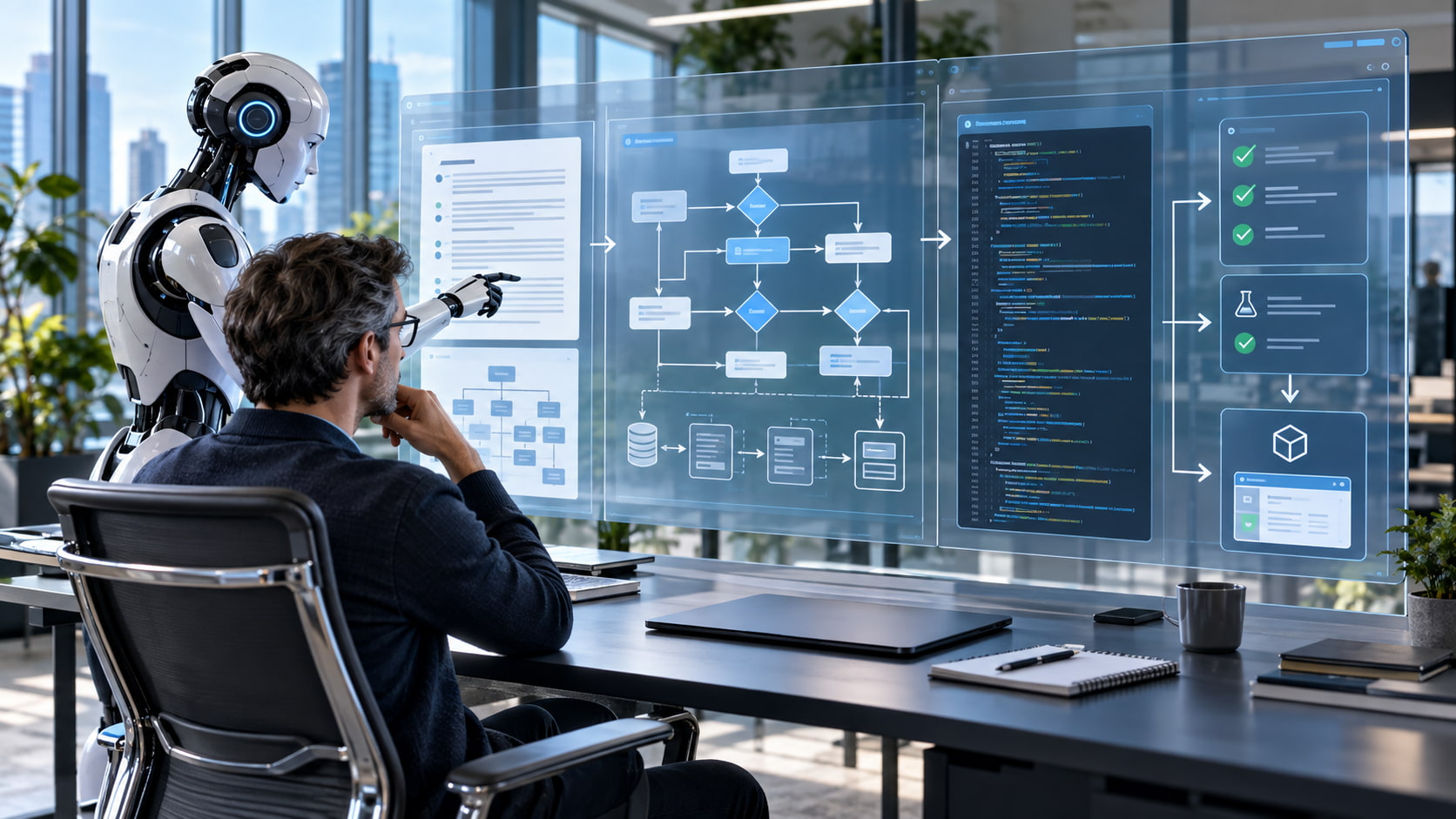
For a long time, code has been considered the central element of software development. Requirements were defined in separate documents, while developers interpreted them and transformed them into functions, modules, and systems.
With the introduction of AI Coding Agents, this way of working is changing. Agents can produce code very quickly, but the result depends directly on the clarity of the information they receive. If a requirement is unclear, AI can rapidly build a solution that works technically but fails to meet the actual business need.
For this reason, a new model is gaining importance: specification-driven development. In this approach, the work does not begin immediately with code. First, the problem, objectives, constraints, edge cases, and criteria by which the result will be evaluated are defined.
Only after these elements are clear do AI and developers move on to implementation.
The Specification Is Becoming the Main Source of Information
In traditional development processes, the specification was often used only during the planning phase. Once work began, the document might no longer be updated, while the code continued to change.
This created a gap between what the business required, what the team understood, and what was actually built.
Specification-driven development attempts to close this gap. The specification is no longer treated as a static document, but as a living artifact that evolves together with the product.
Microsoft Digital describes this approach as a process in which the specification becomes the primary artifact in the development lifecycle. It preserves business intent and acceptance criteria before implementation begins, while being continuously updated alongside the code and tests.
In this way, product managers, architects, developers, designers, testers, and AI Coding Agents work by referring to the same source of information.
Speed Without Clear Direction Can Produce More Problems
AI can generate large amounts of code within a short period of time. However, speed is not useful if the system is being built on unclear requirements or incorrect assumptions.
An agent can create a function, write tests, and propose changes across several files. However, if it does not correctly understand the objective, the result may require a complete revision.
This means that more code can also create more work for the team.
Specification-driven development moves analysis to the beginning of the process. The team attempts to resolve ambiguities, identify edge cases, and define expectations before code is produced.
According to Microsoft Digital’s experience, this helps align stakeholders earlier, reduce rework, and make more controlled use of AI Coding Agents.
What Should a Good Specification Include?
A specification should not describe only the function that is required. It should create the complete context within which the solution will be built.
Depending on the project, the specification may include:
- The problem that needs to be solved
- Business objectives
- User needs
- Expected outcomes
- Technical constraints
- Security standards
- Edge cases
- Acceptance criteria
- Testing methods
- The conditions that define the completion of the task
The more clearly these elements are defined, the easier it becomes for the developer and the AI agent to build a result that matches the original objective.
The specification does not only tell the system what it should build. It also defines what it must not do and where the boundaries of the solution lie.
From a Business Requirement to Testable Code
In specification-driven development, the process may begin with a description of the problem and the expected outcomes. Unresolved questions and ambiguities that could affect the product are then identified.
Once they have been clarified, the technical plan is created. The work is divided into traceable tasks, and the plan is checked to ensure that it aligns with the original requirements.
Only then do implementation and testing begin.
Microsoft Digital divides this process into six main stages: defining the problem and expected outcomes, clarifying ambiguities, creating the technical plan, breaking the work into tasks, validating alignment, and finally implementing and testing the solution.
AI Coding Agents can use the specification to generate code, tests, and documentation. Each result can then be linked to the specific requirement that produced it.
This makes it easier to understand not only what changed in the system, but also why that change was made.
The Specification Must Evolve Alongside the Product
One of the problems with traditional documentation is that it quickly becomes outdated. The product changes, but the document continues to describe the previous version.
In specification-driven development, the document must be updated whenever requirements, constraints, or technical decisions change.
The specification can be stored in the same version-control system as the code. In this way, the team can see what was changed, when it was changed, and how that change relates to the implementation.
This creates a clearer connection between business intent, technical decisions, code, and tests.
Instead of documentation being written after the work is completed, it becomes an active part of the development process.
AI Does Not Replace Technical Judgment
Specification-driven development does not mean that AI makes every decision independently. Agents can accelerate implementation, but people continue to define the objectives, architecture, boundaries, and standards.
The team must verify whether the specification reflects the actual need, whether the technical plan is appropriate, and whether the generated code meets the defined criteria.
Even a detailed specification may contain shortcomings. There may be unanticipated cases, requirements that contradict one another, or constraints that emerge only during implementation.
Human collaboration therefore remains essential. AI can assist in analyzing and completing tasks, but responsibility for the result cannot automatically be transferred to the system.
Roles Within the Team Are Also Changing
When the specification becomes the central point of the process, the way teams collaborate also changes.
Product managers do not deal only with planning and prioritization. They help preserve business intent within the specification.
Architects define the technical principles, security standards, and boundaries that must be respected during implementation.
Developers spend more time analyzing requirements, identifying edge cases, reviewing plans, and verifying results produced by AI.
Testers can connect testing scenarios directly to the acceptance criteria.
The specification therefore becomes a shared agreement among all the participants involved in developing the product.
The Specification Establishes Boundaries for AI Coding Agents
AI Coding Agents need more than a short request. They must understand the architecture, standards, constraints, and expected outcome.
If an agent receives only a general instruction, it may choose a solution that works in the short term but does not fit with the rest of the system.
A complete specification gives the agent clear boundaries. It defines the technologies that can be used, the standards that must be followed, the data that can be accessed, and the actions that require human approval.
This is particularly important in enterprise systems, where every change must comply with security, governance, and auditing requirements.
From Producing Code to Preserving Intent
For Soft&Solution Group, specification-driven development shows that the value of AI in software development does not lie solely in the amount of code it can generate.
Its real value lies in the ability to preserve business intent throughout the entire journey, from the initial requirement to the final solution.
As Ermal Beqiri, founder of Soft&Solution Group, explains:
“When AI can produce code within a few minutes, the main challenge is no longer programming speed. The challenge is ensuring that the system is building exactly what the business requires. The specification creates the connection between intent, technical decisions, and the result that must be verified.”
Specification-driven development is shifting the starting point of software creation. The process no longer necessarily begins with the question of how the code should be written, but with the question of which problem needs to be solved and how the team will determine whether the solution is correct.
In this model, code remains essential, but it is no longer the only source of truth. It becomes the result of a process that begins with clear objectives, defined boundaries, and measurable criteria.
As AI Coding Agents become more capable, the quality of the specification guiding their work will become increasingly important.