
Automation Debt: The Hidden Cost of the Processes We Automate
Date: August 17, 2026
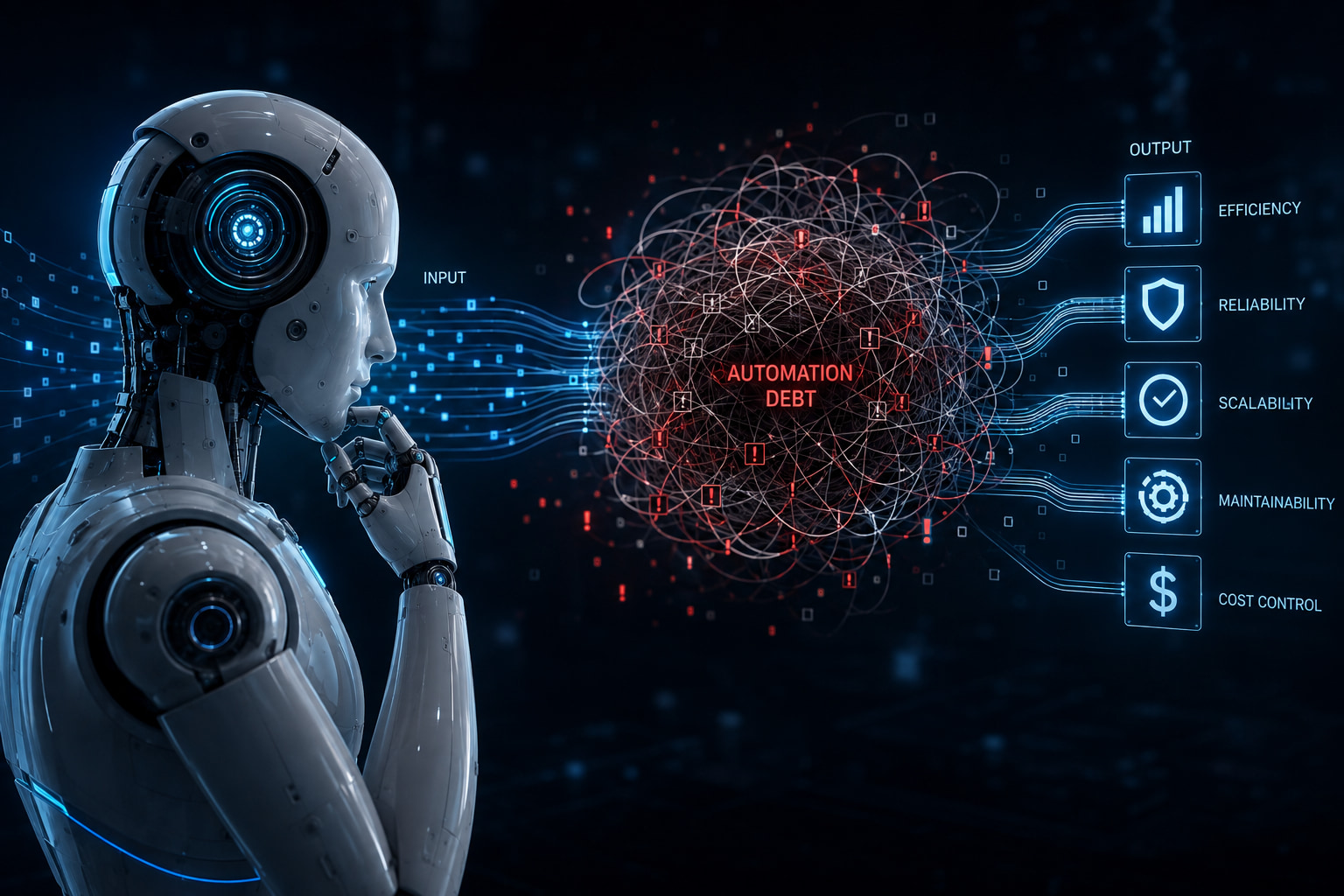
Automation usually begins with a simple question: How can we make this process faster and reduce the need for manual intervention?
One process is automated. Then another. Systems begin exchanging data, actions are triggered automatically, and tasks that once took time can now be completed in seconds.
But after a few years, a different and less obvious question begins to emerge:
Do we still know why each automation works the way it does?
This is where Automation Debt begins: the complexity that accumulates when processes, rules, and integrations are automated but are not reviewed at the same pace as the business evolves.
Automation does not always eliminate complexity. Sometimes, it simply moves it elsewhere.
When a manual process is automated, the visible workload decreases. But the logic behind it still exists.
Somewhere within the system are the conditions, rules, exceptions, dependencies, and integrations that determine what should happen and when.
Over time, more automations are added. One workflow triggers another. One system sends data to another platform. A rule created to address a specific need becomes part of a much larger chain.
Each automation may work perfectly on its own, while the ecosystem as a whole gradually becomes more difficult to understand and change.
This can also be seen in modern enterprise environments, where workflows, configurations, and rules accumulated over time can create new forms of software debt.
A process can keep working even after the reason behind it has changed
Automation has an interesting characteristic: unless we tell it to stop, it keeps going.
But businesses do not work that way.
Processes change. Policies change. Structures evolve. New platforms emerge, and some of the rules that made sense three or five years ago may no longer be the best approach today.
The problem begins when an automation continues to execute a logic efficiently simply because no one has reviewed it for a long time.
At that point, the question is no longer just, “Does it work?”
We also need to ask, “Should it still work this way?”
The more we automate, the more important visibility becomes
In an environment with dozens or hundreds of automated processes, knowing that the systems are running is not enough.
We need to know who is responsible for each process, which systems depend on it, what happens if it fails, and when it was last reviewed.
Documentation, monitoring, and ownership are not secondary elements of automation. They are part of its lifecycle.
This is why modern enterprise automation practices treat governance, monitoring, clear responsibilities, and regular reviews as essential components of automation at scale.
Automation needs to evolve with the process
One of the easiest mistakes to make is to treat automation as a finished project.
It is built, tested, deployed, and then attention moves on to the next process.
But if the process we automated continues to change, the automation supporting it needs to change as well.
That means reviewing rules, removing workflows that no longer create value, checking dependencies, and simplifying parts of the system that have become more complex than necessary.
The goal is not to automate as much as possible.
It is to automate what makes sense and make sure it continues to make sense over time.
As Ermal Beqiri, founder of Soft & Solution Group, says:
“Automation should make things simpler, but that does not mean we should lose sight of what is happening behind it. The more processes we automate, the more important it becomes to understand and stay in control of the logic that keeps them running.”
At Soft & Solution Group, we see automation as something that needs to be managed throughout its entire lifecycle. A well-designed system should not only perform today’s tasks automatically. It should also be documented, observable, and flexible enough to evolve as the organization’s needs change.