
ARM-Based Cloud Computing: How a New Generation of Cloud Servers Is Changing Business Performance
Date: November 18, 2026
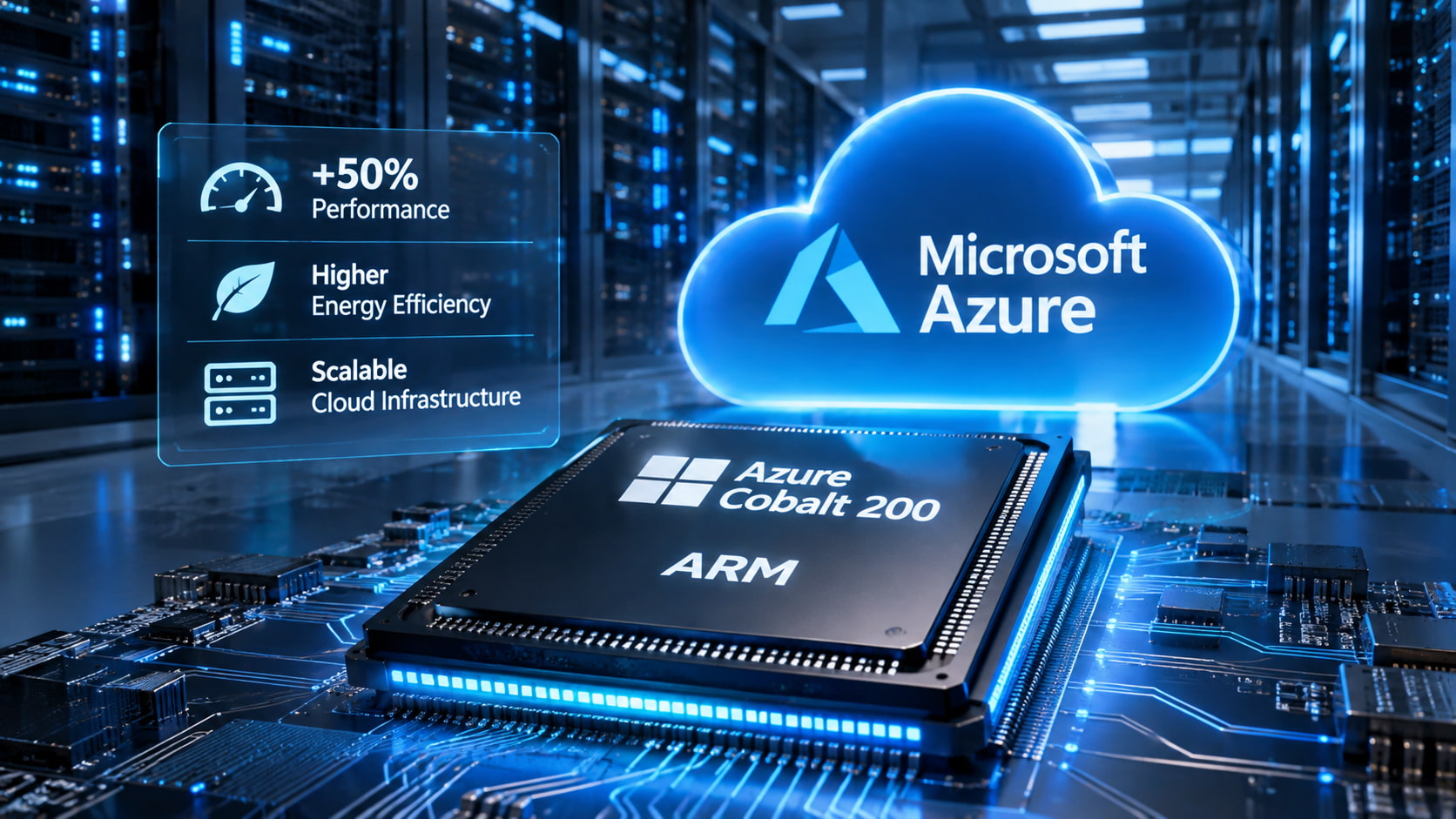
Businesses are asking more of cloud infrastructure. Applications must respond faster, databases must handle growing demand, and digital services must operate with predictable costs. As a result, processor architecture is becoming an important factor when organisations choose cloud servers and virtual machines. One of the major developments is the wider use of Arm-based processors in modern data centres.
On November 17, 2026, at Microsoft Ignite, Microsoft announced the general availability of Azure Cobalt 200 virtual machines. According to Microsoft, these VMs deliver up to 50% better CPU performance than the previous Cobalt 100 generation and are designed for cloud-native applications, data-intensive processing, and agentic AI workloads. At launch, Cobalt 200 was generally available in 14 Azure regions, with expansion to 23 regions planned by the end of 2026.
Source: Microsoft Azure Blog, “Azure Cobalt 200 VMs now available, proven on real workloads and built for the agentic era”, November 17, 2026.
For businesses, this is more than the release of a new processor. It shows that cloud infrastructure is diversifying: alongside traditional x86 servers, providers are investing in Arm processors designed for their own services. Soft & Solution Group sees this as a reason for companies to evaluate not only the price of a virtual machine, but also processor architecture, application compatibility, real-world performance, and total operating cost.
What is ARM-Based Cloud Computing?
ARM-Based Cloud Computing refers to the use of cloud servers and virtual machines powered by processors based on the Arm architecture. Arm is widely used in mobile devices and energy-efficient systems, but in recent years it has expanded into cloud servers. The architecture gives providers an opportunity to design processors tailored to their services, data centres, and specific workload profiles.
In practice, a customer does not purchase a physical processor. Instead, the customer creates a virtual machine in a cloud platform and selects a VM family that runs on Arm processors. The provider manages the physical servers, while the customer uses the operating system, applications, and resources assigned to the virtual machine. Potential benefits include better performance per watt, higher compute density, or a stronger price-performance ratio for particular workloads.
However, Arm is not automatically faster for every program. Results depend on how an application is built, its compilation target, libraries, operating system, memory use, and the characteristics of the workload itself.
What does Azure Cobalt 200 bring?
Azure Cobalt 200 is Microsoft’s second generation of custom Arm processors for Azure. The chip is based on Arm Neoverse CSS V3 and includes 132 Arm Neoverse V3 cores, according to the specifications published by Microsoft. The company says the processor is manufactured using a 3-nanometre process and is part of an integrated approach spanning the CPU, server, networking, storage, and power management.
Microsoft reports up to 50% better CPU performance compared with Cobalt 100. In its own testing, the company reported results that vary by workload: up to 1.5 times for web serving, 1.6 times for Java workloads, 1.5 times for AI-agent tool execution, and 1.9 times for selected database workloads. These figures are Microsoft-published test results and should not be treated as a guarantee for every application or configuration.
Beyond the CPU, Cobalt 200 includes networking and storage improvements through Azure Boost, as well as integrated mechanisms for encryption and acceleration of selected operations. This matters because service performance is not determined by processor speed alone; data movement, storage, networking, and security also affect the final result.
Source: Microsoft Azure Blog, “Azure Cobalt 200 VMs now available, proven on real workloads and built for the agentic era”, November 17, 2026; Arm Newsroom, “Microsoft Azure Cobalt 200 VMs reach general availability”, November 17, 2026.
Arm vs. x86: what is the difference for businesses?
x86 is the architecture used for many years across a large share of enterprise servers and personal computers. Arm uses a different instruction-set architecture and has gained importance in servers because it can be optimised for performance and energy consumption. Businesses should not assume that one architecture is always better than the other.
Cloud-native workloads, microservices, Linux applications, web servers, some databases, and automated processes may benefit from Arm virtual machines when the applications and their dependencies are compatible. By contrast, legacy applications available only as x86 binaries, specialised drivers, or plug-ins without an Arm version may require migration, recompilation, replacement, or continued use of x86 infrastructure.
Before migrating, IT teams should check application architecture, programming languages and runtimes, libraries, container images, monitoring agents, security tools, and integrations with other systems. Operating-system compatibility does not automatically guarantee that every company application will work without changes.
Why is Arm becoming relevant for AI and modern applications?
New-generation AI systems do more than run inference. Autonomous agents can execute code, retrieve data, call APIs, use tools, and coordinate multiple steps. These operations rely on CPUs for logic, process management, databases, caches, and service-to-service communication—even when the model’s main computation runs on a GPU or another accelerator.
Microsoft positions Cobalt 200 for agentic AI-related workloads such as agent sandboxes, file search, code compilation, and tool execution. This does not mean an Arm CPU replaces GPUs for training or inference of large models. Rather, it can improve the general-purpose compute layer that supports agents and the services around them.
Performance and cost: what should companies measure?
A reported performance improvement does not automatically translate into lower cost for every customer. Actual cost is affected by VM size, memory, storage, network traffic, licensing, region, duration of use, and capacity purchasing model. A faster virtual machine may reduce the number of instances required, but only when the application benefits from the architecture and resources are used efficiently.
Businesses should compare cost per request, transaction, user, or completed process—not only the hourly price of a VM. Tests should use data and traffic patterns that resemble real usage. Teams should measure latency, throughput, CPU and memory utilisation, stability under load, and application behaviour as demand increases.
Security, availability, and operating Arm servers
The Arm architecture does not automatically make an environment more secure. Security depends on operating-system configuration, patching, identity and access management, encryption, workload isolation, monitoring, and development practices. For Cobalt 200, Microsoft highlights integrated mechanisms such as Azure Integrated HSM and memory encryption, but organisations should verify which controls are active for their particular configuration and service.
Availability also requires careful design. Moving an application to a new VM family does not replace backups, disaster recovery, redundancy across zones, or monitoring. Companies should maintain a rollback plan in case the application fails to meet performance targets or encounters compatibility issues.
How should businesses prepare for an Arm migration?
The first step is to inventory applications and classify them by criticality, dependencies, and current architecture. Then select a few non-critical workloads for a pilot: web services, microservices, development environments, or batch jobs. Teams should verify that container images and packages are available for Arm64 and that CI/CD pipelines can build and test the relevant versions.
During the pilot, measure performance, cost, stability, and maintenance effort. If the results are positive, migration can be expanded gradually, with a rollback plan and documentation for changes to monitoring, security, and technical support. For some applications, a hybrid Arm and x86 infrastructure may be the most practical option.
Conclusion: cloud computing is becoming more diverse at the processor level
The general availability of Azure Cobalt 200 shows that Arm processors are moving from specialised alternatives toward a more mainstream choice for cloud infrastructure. Microsoft’s published improvements are particularly relevant to web services, databases, cloud-native applications, and workloads supporting AI agents, but actual results should be measured for each application.
For businesses, the right decision is not to move every system to Arm immediately. It is to understand which workloads can benefit, test compatibility, compare total cost, and plan migration without compromising security or availability. Soft & Solution Group recommends a test-and-measure approach in which infrastructure choices are tied to concrete business needs.
As Ermal Beqiri, founder of Soft & Solution Group, explains:
“The future of cloud infrastructure will not be determined by processor power alone, but by the ability to choose the right architecture for each workload while maintaining business performance, security, and efficiency.”