
API Versioning: How Can an API Evolve Without Breaking Existing Integrations?
Date: September 4, 2026
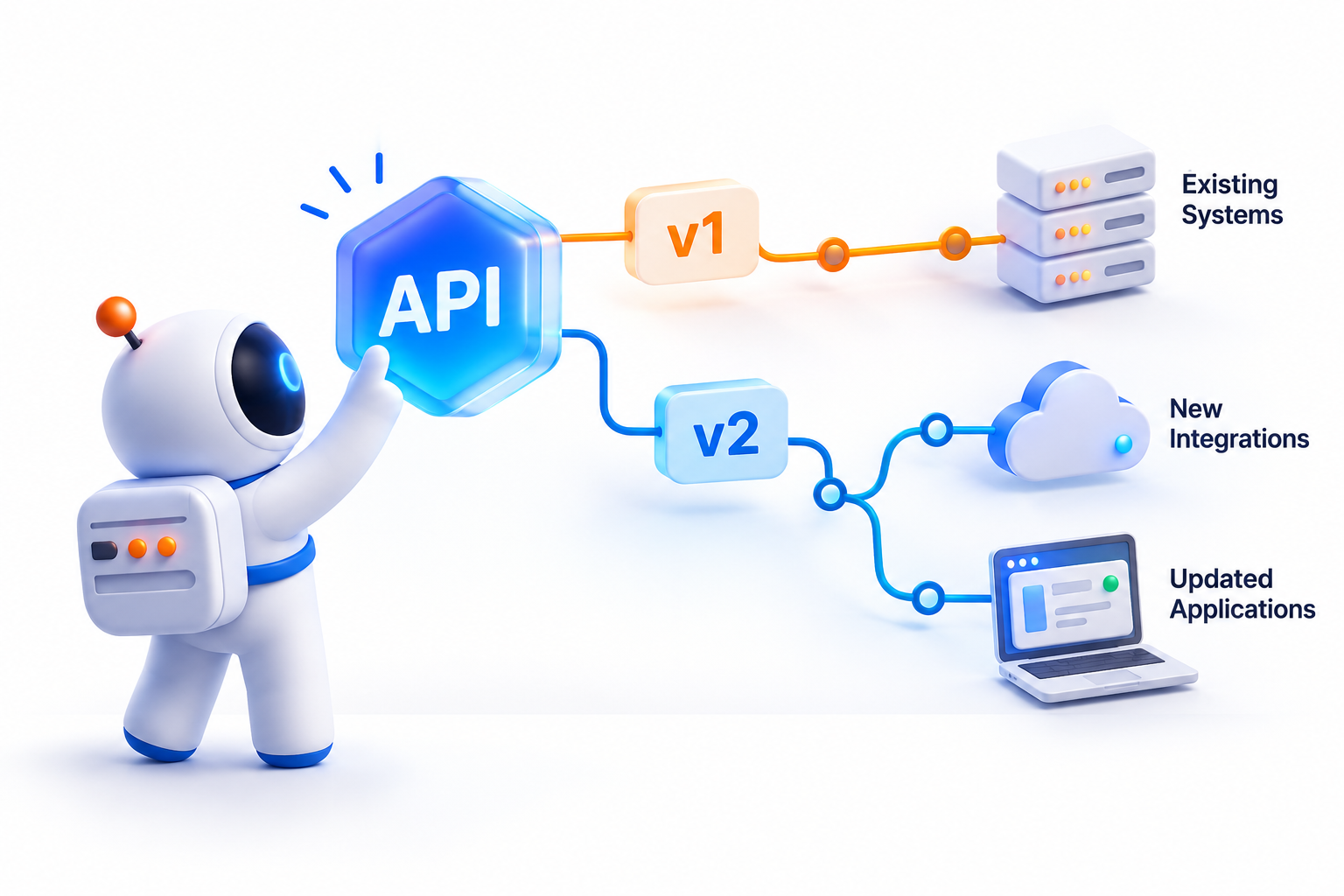
An API may start with a relatively simple function: one application requests data, and another system provides it.
Over time, things change. New fields are added, data structures evolve, functionality improves, and new requirements emerge.
But there is a challenge: the API may have changed, while the systems using it have not.
When several applications, platforms, or services are integrated with the same API, a change that appears minor can affect multiple systems at once.
This is where API Versioning comes in.
When a small change affects multiple systems
Consider a simple example.
An API returns customer information such as a name, address, and contact number. Later, the structure needs to change because the system requires a different way of organizing address data.
For a new application, this may be an improvement. But an existing application may still expect the previous structure.
If the API is changed directly, the existing integration may no longer work as intended.
That is why API development is not only about introducing new functionality. It also requires considering the systems that depend on the API’s current behavior.
A new version can coexist with the current one
API Versioning provides a controlled way to manage this change.
Instead of immediately replacing the existing version, a new one can be introduced. For example, existing systems can continue using v1, while new or updated integrations move to v2.
This means the change does not have to happen across the entire ecosystem at the same time.
Teams have time to adapt their integrations, test the new version, and plan the transition gradually. The previous version can remain supported for a defined period and be retired only once the systems that depend on it are ready.
Not every change requires a new version
API Versioning does not mean that every improvement needs to result in v2, v3, or v4.
Many changes can be introduced while maintaining backward compatibility, without altering the way existing systems communicate with the API.
A new version becomes important when a change cannot be introduced without modifying the API’s existing contract.
This is why versioning is more than a naming convention. It is part of how the evolution of an integration is designed and managed.
An API should also be designed for change
For a software company, good integration is not simply about connecting two systems that need to communicate today.
Systems will change. Applications will be updated. Business requirements will evolve.
Architecture should therefore create room for these changes without turning every update into a problem for other systems.
As Ermal Beqiri, founder of Soft & Solution Group, explains:
“A well-designed API should allow the system to evolve while existing integrations continue to function and the transition to new changes is managed in a controlled way.”
API Versioning is not simply about managing versions. It is about building integrations that can evolve without compromising the operation of existing systems.