
Amazon Transcribe Turbo: The New Generation of Voice AI Improving Customer Communication
Date: November 26, 2026
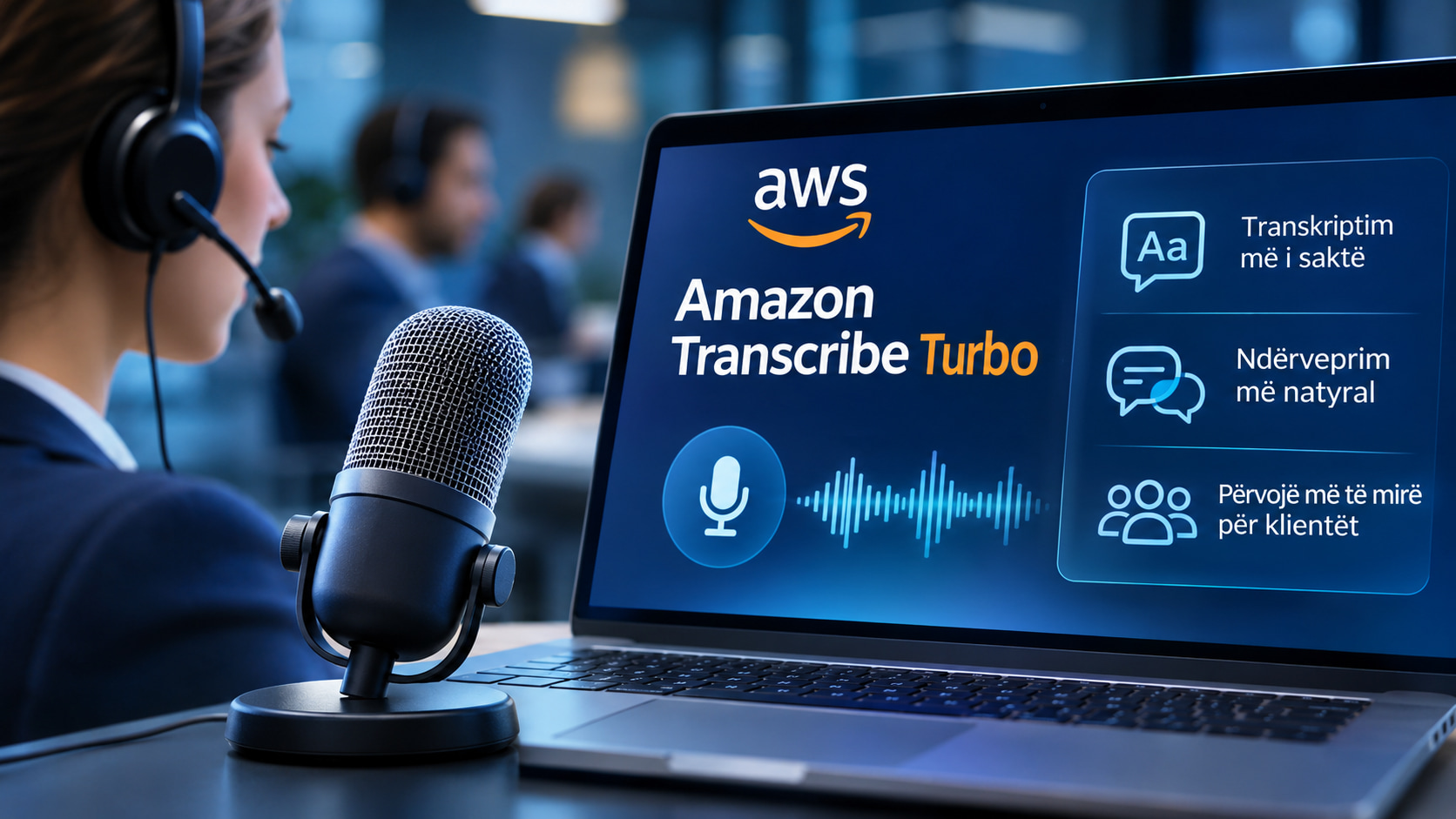
Customer communication is increasingly moving towards automated voice channels. Virtual assistants, IVR systems and Voice Agents are used to route calls, answer questions and support customer-service teams. Yet the quality of these solutions depends on their ability to recognise words, names, numbers and caller intent accurately. Soft & Solution Group follows developments in technologies that can help businesses build more reliable and efficient digital interactions.
On November 25, 2026, Amazon Web Services (AWS) announced Amazon Transcribe Turbo, a next-generation speech-to-text model that entered public preview for batch and streaming workloads in the US East (Ohio) Region. According to AWS, the model is designed to improve transcription accuracy, spoken-data formatting and the way Voice Agents determine when a caller has finished speaking. The release is a public preview intended for testing, not production workloads.
The announcement goes beyond converting speech into text. Amazon Transcribe Turbo also introduces two streaming features for Voice Agents: semantic turn-taking, which uses the content and delivery of speech to detect the end of a conversational turn, and runtime ASR hints, which provide context before the next response. These capabilities may help reduce unnecessary interruptions and improve how customer requests are routed.
What is Amazon Transcribe Turbo?
Amazon Transcribe Turbo is AWS’s next-generation Automatic Speech Recognition (ASR) model. It converts audio into text and supports batch transcription, where an audio file is processed, as well as streaming, where text is generated while audio is transmitted. It also formats numbers, dates, currencies, phone numbers and addresses according to the conventions of the selected locale.
How much has transcription accuracy improved?
According to measurements published by AWS, streaming Word Error Rate (WER) is reduced by approximately 14% relatively for English and 11% for Portuguese, French, Italian, German and Spanish compared with the current production model. For batch transcription, AWS reports around 16% fewer word errors for several preview languages and around 6% fewer character errors for Chinese, Japanese and Korean. These are AWS-reported results, not a guarantee for every audio type or business environment.
How does semantic turn-taking work?
Traditional voice systems often wait for a fixed period of silence before deciding that a caller has finished speaking. This can interrupt someone who pauses briefly mid-sentence or delay a response to short answers such as “yes” and “no”. Semantic turn-taking analyses the meaning of what was said and speech characteristics, rather than relying on silence alone. AWS reports a response time of about 615 milliseconds and a 5% interruption rate in its published configuration; the behaviour can be tuned for an application’s needs.
What are runtime ASR hints?
Runtime ASR hints provide the recognition system with contextual information before each conversational turn. An application can send menu options, expected names or the expected data type, such as a date, phone number or currency amount. This differs from static custom vocabulary, which is generally configured at the start of a session. On English customer-service data, AWS says hints increased menu-routing accuracy from 87% to 97%.
What benefits could this bring to customer service?
The combination of more accurate transcription, contextual recognition and more natural turn detection may improve customer experiences in contact centres and IVR systems. A Voice Agent may better understand menu selections, product names or information shared during a call. This can reduce repeated questions and help route requests to the right department. Actual results depend on audio quality, configuration and testing with a business’s own conversations.
Does it require changes to existing integrations?
AWS states that the base Transcribe Turbo model does not require API, code or SDK changes. However, the new Voice Agent features require dedicated configuration for end-of-turn detection and the delivery of context through the relevant events. Changes in number, date and identifier formatting may also affect applications that expect a specific text structure. Technical teams should validate parsing, masking and data-processing logic during testing.
What are the availability limits?
In its November 25, 2026 announcement, AWS said the public preview for batch and streaming was available in the US East (Ohio) Region. Streaming supports English, Portuguese, French, Italian, German and Spanish. Several additional languages are in batch preview, while English batch transcription is generally available in most AWS Regions. The two new Voice Agent features launched in English, with support for other languages planned by the end of December 2026. AWS describes the preview as a testing environment, not for production workloads.
How should businesses prepare?
Businesses using or planning to use Voice AI should test the technology with real recordings and representative customer scenarios. They should measure transcription errors, premature interruptions, response time, call-routing accuracy and the handling of numbers or personal data. Privacy, audio retention, security and regulatory requirements also need to be assessed. Controlled testing helps determine whether the model’s improvements deliver measurable value to business processes.
Conclusion: Voice AI is moving towards more natural and accurate conversations
Amazon Transcribe Turbo shows that Voice AI development is no longer only about recognising words; it is also about understanding conversational context and timing. For businesses, these improvements may create opportunities for more efficient customer service, better automation and more natural interactions. However, preview availability and usage limitations mean that careful testing is necessary before any production integration decision. Soft & Solution Group views the evaluation of such technologies as an important part of preparing businesses for more advanced digital services.
As Ermal Beqiri, founder of Soft & Solution Group explains:
“Voice AI is becoming an important point of contact between businesses and their customers. Its real value comes not only from faster transcription, but from the system’s ability to understand a request accurately and respond at the right moment. Businesses should test these solutions against real processes, keeping quality, security and customer experience at the centre.”