
AI Agents: From Software That Executes to Software That Decides
Date: July 3, 2026
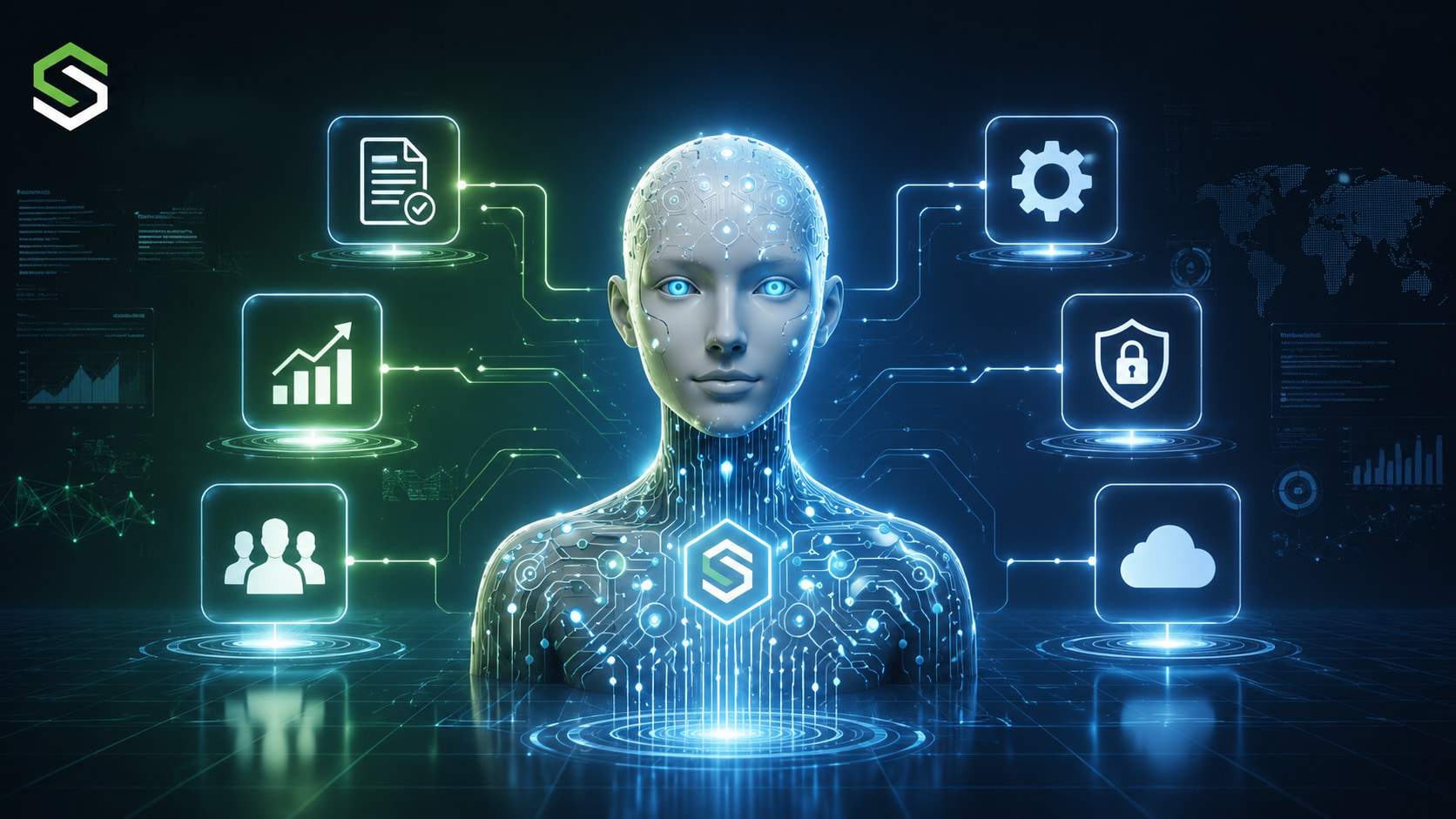
For decades, software has followed a familiar model.
The user gives a command.
The system executes it.
This approach remains the foundation of most software platforms we use today. However, the rise of Artificial Intelligence is driving a much more profound shift than simply automating individual tasks.
We are entering a new generation of software where systems are no longer limited to executing commands. They can analyze information, understand context, make decisions based on predefined rules, and collaborate with other systems to complete entire workflows.
These systems are known as AI Agents.
AI Agents Are More Than Chatbots
Artificial Intelligence is often associated with chatbots or virtual assistants.
In reality, a chatbot is simply a communication interface.
An AI Agent operates on an entirely different level.
It can analyze documents, interpret data, plan the steps required to achieve a goal, interact with other systems through APIs, and execute complete workflows with minimal human intervention.
Instead of simply responding, it takes action.
That is the shift redefining the future of software.
Enterprise Platforms Are Becoming Smarter
In enterprise environments, AI Agents are not introduced as just another feature.
They become part of the platform’s core architecture.
An AI Agent can analyze contracts, process documents, monitor financial operations, detect anomalies, generate reports, and support real-time decision-making.
The result is not just automation.
The result is a platform that enables organizations to operate faster, make better decisions, and gain deeper operational insight.
The Potential Extends Across Every Industry
AI Agents are rapidly finding applications across virtually every sector.
In GovTech, they can classify documents, automate administrative workflows, validate data, and help institutions process requests more efficiently.
In FinTech, they can analyze transactions, identify unusual patterns, support compliance processes, and accelerate financial analysis.
In healthcare, they can organize clinical documentation and assist in analyzing medical data.
In logistics, they can optimize planning, coordination, and operational workflows.
The principle remains the same.
AI does not replace experts.
It removes repetitive work, allowing professionals to focus on decisions that require expertise, judgment, and experience.
Architecture Determines Success
An AI Agent does not create value on its own.
Its effectiveness depends on the platform it is built into.
APIs, interoperability, cloud infrastructure, data governance, observability, and cybersecurity are the technologies that enable AI Agents to communicate with other systems, securely access data, and operate reliably within enterprise environments.
The stronger the architecture, the greater the potential of Artificial Intelligence.
From Automation to Intelligent Decision Support
For many years, automation had a single objective: eliminating manual tasks.
AI Agents take that concept much further.
They do not simply automate actions.
They analyze situations, recommend alternatives, prioritize tasks, and support users throughout the decision-making process.
That is why many organizations no longer view AI Agents as another software feature.
They see them as a new architectural layer within modern enterprise platforms.
The Next Generation of Software
Tomorrow’s software will not be defined solely by the number of features it offers.
It will be defined by its ability to collaborate with users, understand context, and execute processes autonomously.
Software will no longer be just a tool waiting for instructions.
It will become an intelligent partner that supports decision-making and continuously improves operational efficiency.
Our Vision
At Soft & Solution Group, we believe AI Agents will be one of the most significant developments in the evolution of enterprise software over the coming years.
Modern software architectures will no longer focus solely on adding new features. They will focus on building systems that analyze, learn, collaborate, and evolve alongside the organizations that rely on them.
As Ermal Beqiri, founder of Soft & Solution Group, says:
“We’re entering a new phase where we’re building systems that understand context, collaborate with users, and support better decision-making. I believe this will be one of the biggest shifts we’ll see in software development over the years ahead.”
AI Agents are more than just another software capability.
They represent a fundamentally new way to design, build, and use enterprise software for the next generation of digital platforms.