
A2A Protocol: How Is Integration Changing in the Age of AI Agents?
Date: August 24, 2026
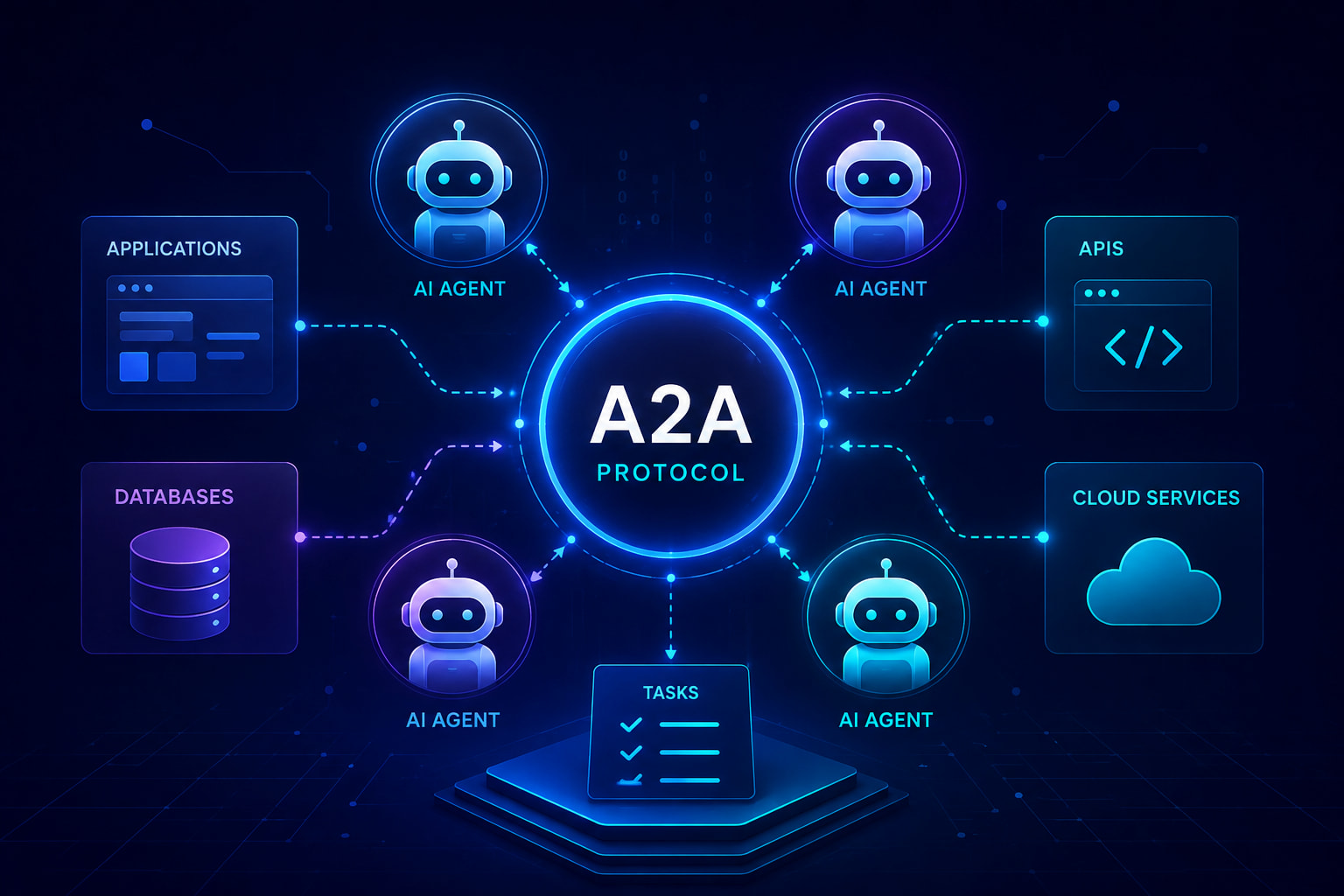
System integration has always been an important part of software development. APIs created a standardized way for applications to exchange data and use each other’s functionality.
Now, with the development of AI Agents, a new need is emerging: systems must not only exchange information, but different agents must also be able to collaborate and delegate tasks to one another.
This is where Agent2Agent Protocol (A2A) comes in, an open standard designed for communication between AI Agents.
For companies that build and integrate software systems, this opens a new chapter in interoperability.
From application integration to agent integration
In a traditional architecture, one system can use another system’s API to request or send information.
With A2A, this interaction goes one step further.
An agent can identify another agent’s capabilities, delegate a task to it, and receive the result, even when the two are built on different technologies.
This is particularly relevant for enterprise systems, where a single process may span multiple applications, databases, and services. Instead of building every connection between agents as a separate integration, A2A aims to establish a common way for them to communicate.
A new standard within software architecture
A2A does not replace APIs or existing integrations. It adds another layer for systems where AI Agents become part of the architecture.
The distinction from MCP (Model Context Protocol) is also important. MCP helps an AI system connect to tools, APIs, and data sources, while A2A focuses on communication and collaboration between agents themselves.
In practice, these technologies can coexist within the same architecture: an agent can interact with existing systems through APIs and MCP, while A2A enables it to collaborate with other agents.
What changes for system development?
For us, the most interesting aspect of A2A is not just the protocol itself, but the direction it points to for software development.
If AI Agents become part of enterprise systems, architecture must define not only how applications communicate, but also how agents discover one another, how tasks are delegated, how access is controlled, and how interactions between them are monitored.
Integration does not disappear. On the contrary, it becomes even more important.
As Ermal Beqiri, founder of Soft & Solution Group, says:
“A2A introduces a new layer to system integration. When AI Agents become part of the architecture, connecting them to existing data and applications is no longer enough. We also need to define how they communicate and collaborate with one another, while maintaining control and security across the entire system.”
For a software company, this is also one of the most interesting developments around A2A: AI Agents are not only creating new applications. They are introducing a new type of component that needs to be integrated into the existing architecture.